







A Landmark Leap into Orbit
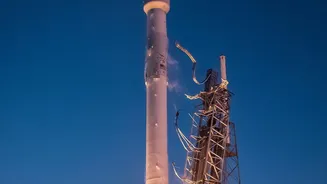
On September 28, the world's most powerful rocket, Starship, launched from Texas on its 14th test flight. Unlike its 13 predecessors which flew on suborbital paths, this mission had a far grander ambition: to enter a sustained low-Earth orbit. The Super
Heavy booster, with its 33 engines, successfully propelled the upper stage towards space before separating and performing a controlled splashdown in the Gulf of Mexico. The Starship upper stage then fired its own engines and, despite some heart-stopping moments in mission control, pushed into orbit for the first time ever, a critical step that transitions the program from atmospheric testing to true space operations.
Delivering on a Key Promise
Reaching orbit wasn't the only objective. For the first time, Starship deployed an operational payload. The vehicle released 26 next-generation Starlink V3 satellites into the company's massive internet constellation. Previous tests had carried dummy payloads, but this marked Starship's debut as a functional cargo delivery system, demonstrating a capability vital to its business case. According to SpaceX, a single Starship launch of these new satellites adds roughly ten times the network capacity of a launch using its workhorse Falcon 9 rocket, highlighting the immense commercial potential of the new system.
An Anomaly and a Change of Plans
The flight was not without its flaws. During the ascent, one of the Starship upper stage's six Raptor engines shut down prematurely. After nail-biting deliberations, flight controllers determined the vehicle could still safely achieve orbit by burning its remaining engines for longer, and they proceeded with the orbital insertion. However, the original plan called for a nearly 10-hour mission with six orbits. Out of what SpaceX called “an abundance of caution” due to the engine issue, the company made the call to shorten the flight significantly. Instead of a long-duration coast, the mission was rerouted for an earlier reentry.
Why an Early Return Still Matters
Ending the mission after about three hours instead of ten might seem like a major failure, but within SpaceX's rapid-development philosophy, it's a valuable learning experience. The shortened flight still allowed the spacecraft to achieve its primary goals: reaching orbit and deploying its payload. It also provided a real-world test of the deorbit burn and atmospheric reentry, culminating in a splashdown in the Pacific Ocean. Even the engine failure provides crucial data for engineers to analyze and fix for future flights. This iterative approach—fly, test, fail, fix, and fly again—is fundamental to how SpaceX has accelerated rocket development. The data gathered from this 'abbreviated' success is arguably more valuable than a flawless flight with fewer lessons learned.
The Road Ahead for Starship
This successful, if imperfect, orbital flight unlocks the next phase of Starship's development. The company still has major hurdles to clear, including perfecting the recovery and reuse of both the Super Heavy booster and the Starship upper stage by catching them with the launch tower's giant mechanical arms. In-space refueling, which involves transferring propellant between two Starship vehicles in orbit, is another critical technology that must be proven for the vehicle to undertake deep-space missions. NASA is relying on Starship to be the crewed lander for its Artemis program to return astronauts to the Moon, so demonstrating reliability and safety is paramount. While this flight was a giant leap, the journey to making Starship a routinely operational, fully reusable launch system is just beginning.