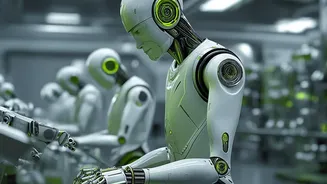






The rise of Artificial Intelligence is sparking a dual narrative across India's offices. Is it a job-killer or a productivity booster? The truth lies somewhere in between, creating a complex new reality for hiring, skills, and career progression.
AI Is Creating New Roles, Not Just Eliminating Old Ones
The common
fear is that AI will lead to mass job losses. While it is true that AI will automate many repetitive tasks, the bigger picture shows a significant shift in the job market rather than a simple reduction. Projections suggest that while millions of jobs will be displaced, even more will be created. These new roles are not just for coders and data scientists. Entirely new job categories are emerging, such as AI prompt engineers, AI quality analysts, and ethical AI consultants, which require a mix of technical and business understanding. Research shows companies adopting AI are actually expanding their workforces faster than those that have not. The challenge isn't a lack of jobs, but a mismatch between the skills required for these new roles and the skills the current workforce possesses.
The Rising Value of ‘Human’ Skills
As AI handles more data-driven and analytical tasks, skills that are uniquely human have become more valuable than ever. A recent LinkedIn survey found that 92% of executives in the US believe soft skills are increasingly important. These include critical thinking, problem-solving, communication, emotional intelligence, and adaptability. AI can generate a report, but it cannot read the room during a tense negotiation, mentor a junior employee, or devise a creative solution to an unexpected business crisis. For this reason, employers are prioritising candidates who demonstrate strong interpersonal capabilities, viewing them as essential for navigating the complexities of an AI-integrated workplace.
Experienced Staff Are Gaining an Edge
Contrary to fears that older workers would be left behind, recent data indicates that companies adopting AI are hiring senior professionals at a much faster rate than junior ones. One study showed that senior employment at AI-adopting companies grew by 31%, compared to just 6% for junior roles. Experienced employees bring deep industry knowledge, strategic judgment, and leadership—qualities that AI cannot replicate but can augment. Their expertise is crucial for guiding AI implementation, validating its outputs, and ensuring that new technologies deliver real business value rather than just productivity gains. This trend does, however, raise concerns about the pipeline for future leaders if entry-level hiring continues to slow.
The Upskilling and Reskilling Imperative
The gap between available skills and future needs is the central challenge. The World Economic Forum has estimated that a significant portion of the global workforce will require reskilling or upskilling in the coming years. This is not just about learning to code. It is about achieving 'AI literacy' or 'AI fluency'—the ability to use AI tools effectively, evaluate their outputs critically, and integrate them into daily workflows. Companies are increasingly realising that investing in AI tools without investing in their people is a recipe for failure. Strategic workforce planning now involves identifying roles likely to be transformed by AI and creating clear pathways for employees to gain the necessary new skills.
Hiring for Adaptability, Not Just Credentials
In a rapidly changing landscape, a candidate's past experience and qualifications are only part of the story. Increasingly, hiring managers are looking for a crucial trait: adaptability and a capacity for continuous learning. The jobs of tomorrow are still being defined, and the most valuable employees will be those who can evolve alongside technology. This shifts the focus from hiring someone who has the perfect skill set today to hiring someone who has the potential to learn the skills needed for tomorrow. This involves assessing a candidate's curiosity, resilience, and willingness to embrace new tools and processes.
The Messy Reality of AI in Recruitment
While AI offers powerful tools for business, its use in hiring is creating new headaches. A large percentage of employers now use AI to screen resumes, leading to an 'automated arms race'. Candidates use generative AI to optimise their applications with keywords, making it harder for hiring managers to determine authentic skills and experience. This has, in some cases, increased the time spent validating credentials through extra interviews and skills assessments. Furthermore, there is a persistent risk that AI screening tools, if not properly audited, can inherit and automate historical biases from past hiring data.