




A Giant Awakens in Data
In 2026, scientists from the British Geological Survey (BGS) and the University of Oslo announced a groundbreaking discovery: evidence of a massive volcano buried deep beneath the counties of Lincolnshire and Norfolk. There is no mountain or crater visible
today; the entire system is concealed under thick layers of younger rock. The discovery didn't come from a new excavation, but from a fresh look at old evidence. Researchers re-examined rock samples that were retrieved from boreholes drilled decades ago, some as far as 65 kilometers apart. Using cutting-edge technology, they were able to unlock the secrets held within tiny crystals, revealing a dramatic geological past that had remained hidden for hundreds of millions of years.
A Journey to the Ordovician World
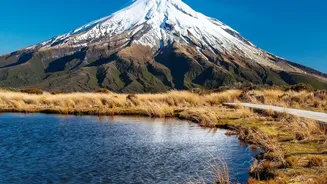
To understand this volcano, one must travel back in time 454 million years to the Late Ordovician period. The world was unrecognisable. The landmass that would eventually become England was part of a microcontinent called Avalonia. It was separated from the continent that included modern-day Scandinavia by a body of water known as the Tornquist Sea. This region was not the quiet, stable land it is today. Instead, it was a dynamic volcanic arc, similar to the Pacific's 'Ring of Fire', where one tectonic plate was sliding beneath another, melting rock and feeding a chain of powerful volcanoes. The Eastern England volcano was one of these fiery giants.
The Zircon Detective Story
The key to unlocking this ancient mystery lay in microscopic zircon crystals, each smaller than the diameter of a human hair. These incredibly durable crystals form in magma before an eruption. Crucially, they contain trace amounts of uranium, which decays into lead at a perfectly predictable rate. By measuring the ratio of uranium to lead, scientists can date the crystal with remarkable precision. The BGS team analysed zircons from the English borehole samples and found they were all approximately 454.4 million years old. This proved they all came from a single, massive eruption. But the real breakthrough came when they compared this age to that of the Kinnekulle tephra—a thick layer of volcanic ash found across Scandinavia. The ages matched almost perfectly, solving the long-standing puzzle of where this widespread ash layer had originated.
An Eruption of Epic Proportions
The connection between the English volcano and the Scandinavian ash reveals the sheer scale of the eruption. Scientists describe it as an 'ultraplinian' event, the most violent type of volcanic explosion known. It would have blasted hundreds of cubic kilometres of rock, ash, and gas into the stratosphere, with a force equivalent to thousands of powerful bombs. The resulting ash cloud, towering more than 25 miles high, was caught by high-altitude winds and blown across the Tornquist Sea, eventually settling on the seafloor of ancient Scandinavia. This event was so significant that it left a permanent marker in the geological record of an entirely different continent.
From Fiery Peak to Buried Secret
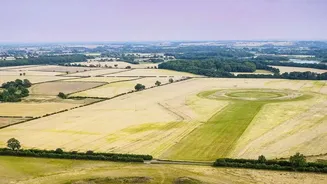
So, if this volcano was so immense, where did it go? The answer lies in the immense timescale of geology. After its period of activity, the volcano went extinct. Over the subsequent 450 million years, the processes of erosion wore down its mountainous peak. Simultaneously, the landmass slowly subsided, sinking below sea level. For millions of years, layers of sediment—mud, sand, and the remains of marine creatures—settled on top, burying the volcano's remnants deeper and deeper. These sediments eventually hardened into the layers of mudstone and limestone that now lie thousands of feet thick above the ancient volcanic rock, creating the flat landscape we see today.