





The Dawn of a New Space Age in India
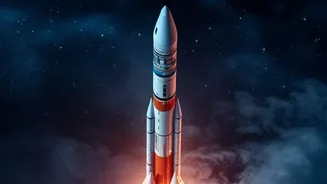
Founded in 2022 by Manu J Nair, Shubhayu Sardar, and Prashant Sharma, EtherealX is at the heart of India's burgeoning private space sector. The company has a bold mission: to develop the 'Razor Crest Mk-1,' a medium-lift rocket designed to be entirely
reusable. This isn't just about saving parts; it's about fundamentally changing the economics of space access. The government's decision to open the space sector to private participation in 2020 has catalyzed a new wave of innovation, with the number of Indian space startups growing from a handful to over 400. This policy shift, institutionalized by the Indian Space Policy 2023, aims to grow India's share of the global space economy from its current estimated $8.4 billion to $44 billion by 2033. EtherealX is a prime example of this new ambition in action.
Why Full Reusability is a Game-Changer
For decades, rockets were single-use machines. Imagine flying from Delhi to Mumbai in a plane, only to discard the entire aircraft upon arrival. That's been the reality for space launches, making them incredibly expensive. SpaceX's Falcon 9 began to change this by successfully landing and reusing its first-stage booster. EtherealX wants to take this a giant leap further by recovering and reusing both the booster and the critical upper stage of its rocket. Co-founder Manu J Nair has stated their goal is to fundamentally change how medium-lift launchers work. Successfully achieving this would drastically lower the cost of sending satellites and other payloads into orbit. The startup aims to slash launch costs to a target range of $500 to $1,000 per kilogram, a massive reduction from current rates.
The Technology Behind the Ambition
The primary challenge in recovering an upper stage is the intense heat of atmospheric reentry. Instead of relying on heavy, expensive heat shields, EtherealX has developed an innovative engine system. This proprietary technology, known as the Full-flow Segregated Cooling Cycle (FSCC), uses leftover fuel for both cooling and propulsion during the reentry phase, making the system lighter and more efficient. The company has already developed two engines to power its vehicle, including the 80kN reusable upper-stage engine named 'Pegasus'. This focus on in-house innovation is crucial as India still depends on imports for some high-end space technologies.
Navigating a Competitive Landscape
EtherealX is not just competing in a vacuum. It operates in a landscape dominated by established global players and the revered Indian Space Research Organisation (ISRO). ISRO is also developing its own reusable technology, with its 'Pushpak' Reusable Launch Vehicle (RLV) program successfully completing several landing experiments. However, the government's reforms are designed to foster collaboration, not just competition. The goal is to allow ISRO to focus on advanced research and national missions, while private players like EtherealX scale up mature technologies for the commercial market. EtherealX has already signed collaboration agreements with IN-SPACe (the national space regulator) and ISRO, positioning itself as a key partner in India's broader space ecosystem.
The Road Ahead: Funding and Milestones
Rocket science is famously capital-intensive. EtherealX has shown significant progress in securing investor confidence. After an initial seed round of $5 million in 2024, the company raised a substantial $20.5 million in a Series A round in early 2026. This funding is critical to accelerate the development of the Razor Crest Mk-1. The startup's roadmap includes a crucial engine test planned for November 2026 and a technology demonstrator flight in 2027. The first commercial launch of the full vehicle is targeted for the end of 2028. While the challenges of building, testing, and qualifying space hardware are immense, EtherealX's ambition and investor backing signal a powerful new current in Indian enterprise.