



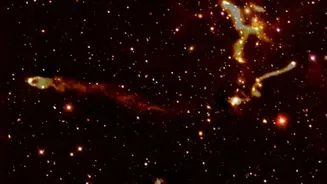

A Cosmic Powerhouse in Miniature
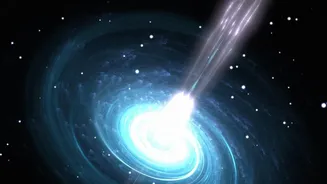
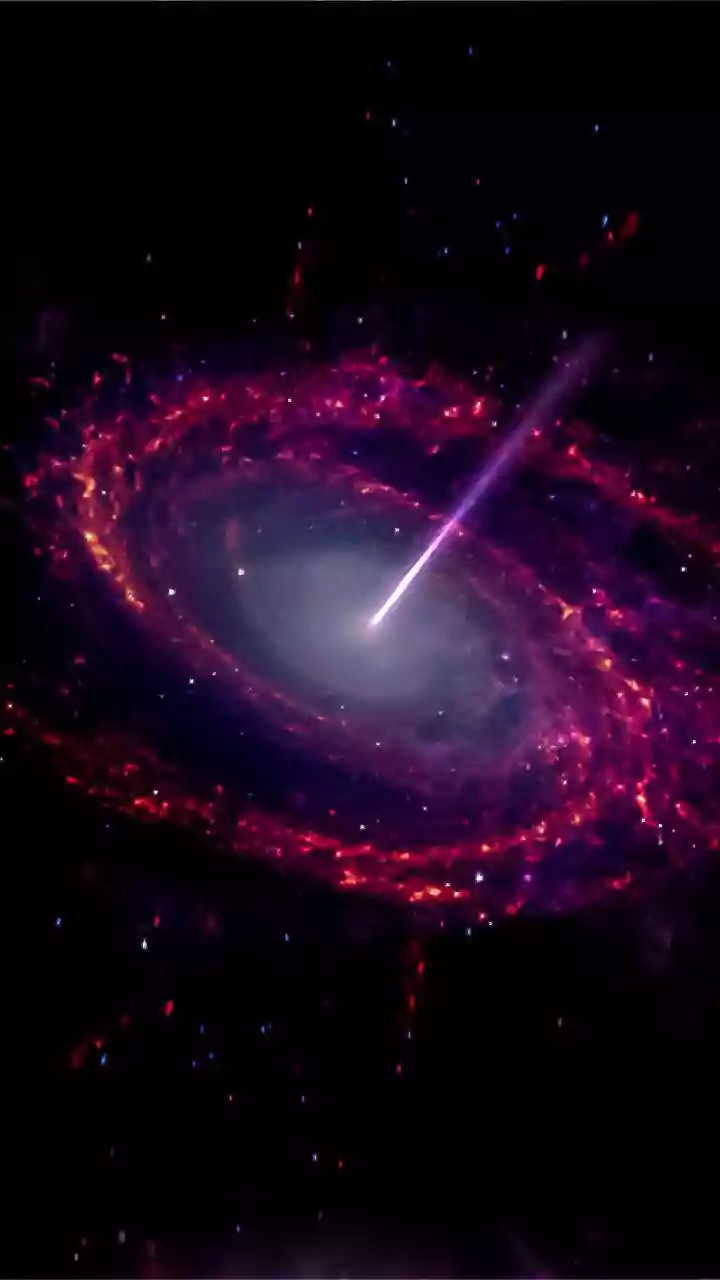
To understand the excitement, we first need to talk about blazars. These are some of the most energetic phenomena in the known universe. They occur when a supermassive black hole at the center of a distant galaxy feeds on surrounding gas and dust. This
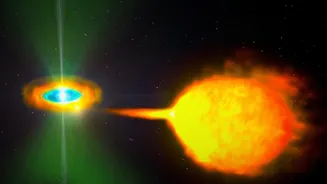
process launches two powerful jets of ionized matter in opposite directions at nearly the speed of light. When one of these jets happens to be aimed almost directly at Earth, we call the object a blazar. The jet's orientation makes it appear incredibly bright due to an effect called relativistic beaming. For years, scientists have theorized that a smaller version should exist: a 'microblazar'. Instead of a supermassive black hole, a microblazar would be powered by a much smaller stellar-mass black hole, just a few times the mass of our sun, feeding on a companion star.
Introducing IRAS 18293-0941
Located about 12,000 light-years away, IRAS 18293-0941 is a binary system hidden behind dense clouds of interstellar dust. An international team of researchers, using data from multiple observatories, identified it as a system containing a black hole about 10 times the mass of the Sun and a massive companion star. The two objects orbit each other every 11 days. As the black hole strips material from its stellar partner, it powers a jet of particles traveling at about 75% the speed of light. Crucially, observations show that this jet is pointed very close to our line of sight, making it a prime candidate for the first confirmed microblazar in the Milky Way.
The Case for Caution
Despite the compelling evidence, astronomers are careful to label IRAS 18293-0941 a 'candidate' for now. The scientific process requires rigorous confirmation before a discovery can be officially declared. One missing piece of the puzzle is the object's variability. Blazars, and theoretically microblazars, are known for rapid and dramatic fluctuations in brightness as a result of their Earth-facing jets. So far, IRAS 18293-0941 has not shown these expected rapid changes. Researchers suggest this could be because a dense envelope of gas and dust surrounding the system is smoothing out the light variations. Further observation is needed to either detect this variability or confirm that it can be absent in a genuine microblazar.
The Path to Confirmation
Confirming the status of IRAS 18293-0941 will involve an intense, coordinated effort using some of the world's most powerful telescopes. Astronomers will continue to monitor the system across the entire electromagnetic spectrum, from radio waves to high-energy gamma rays, looking for the tell-tale signs that will solidify its identity. This includes searching for the faint flicker of variability and mapping the jet's interaction with the surrounding interstellar medium in even greater detail. The system's proximity to a region of unexplained ultra-high-energy particles also adds another layer of intrigue, as scientists investigate whether the microblazar's unseen jet could be responsible for accelerating them. These next steps are a critical part of the astronomical discovery process, moving from a promising hint to a confirmed reality.
Why Microblazars Matter
Discovering a microblazar in our own cosmic backyard would be a major breakthrough. Because blazars are located in distant galaxies, their inner workings are difficult to study. A nearby microblazar like IRAS 18293-0941 would serve as an invaluable 'cosmic laboratory'. Since processes happen much faster in these smaller systems, astronomers could observe the physics of black hole accretion and jet formation on human timescales. It would offer unprecedented insights into how black holes pour energy into their surroundings and could help solve long-standing mysteries about the origin of some of the most energetic particles in our galaxy. Fortunately, despite its jet pointing our way, the object is too far away to pose any threat to Earth.