



A Cosmic Dance of Giants
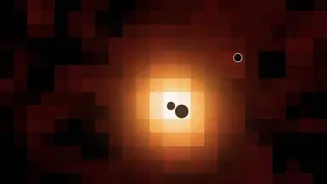
Deep in the cosmic past, more than 12.5 billion years ago, a dramatic scene unfolded that we are only now witnessing. Astronomers, pointing the powerful James Webb Space Telescope (JWST) at a galaxy named J0148-4214, have uncovered compelling evidence
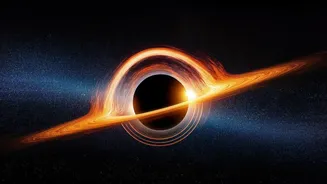
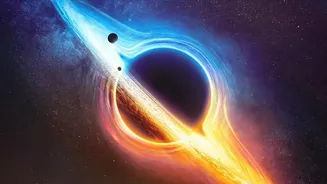
of three supermassive black holes locked in a gravitational dance. Two of these cosmic monsters are nestled closely together at the galaxy's core, separated by a mere 620 light-years—a tiny distance in cosmic terms. A third black hole lurks on the outskirts, suggesting a complex and violent history of galactic collisions. This is the first time such a crowded system has been confirmed so early in the universe's history, a period just over a billion years after the Big Bang. The discovery provides a thrilling, real-world example of how the universe's largest structures are built.
How Webb Pierced the Veil
Finding these black holes was a remarkable feat of technological prowess. Black holes themselves are invisible, so scientists must hunt for the evidence they leave on their surroundings. The team used an instrument on the JWST called the Near-Infrared Spectrograph (NIRSpec). Specifically, they employed its Integral Field Unit (IFU), which acts like a scientific version of an MRI machine for galaxies. Instead of taking a single picture, the IFU captures a 'data cube', providing a detailed spectrum for every single pixel in its view. This allowed astronomers to map the movement of gas throughout the galaxy with incredible precision. They couldn't see the black holes directly, but they could see the brilliant, superheated hydrogen gas swirling around them at furious speeds.
The Telltale Signs in Light
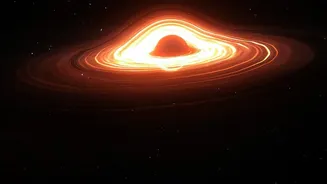
The key to the discovery was analysing the light from hydrogen atoms. As gas is pulled towards a black hole, it forms a rapidly spinning accretion disk and heats up, glowing intensely. The incredible speeds of this gas—thousands of kilometres per second—stretch and distort the light it emits, creating a unique 'spectral fingerprint'. In the case of J0148-4214, the spectrum from the galaxy's core was unusually complex. Using the detailed IFU data, scientists were able to disentangle the light, revealing that it wasn't coming from one source, but two distinct regions of rapidly moving gas. This indicated the presence of the close central pair of black holes. A third, similar signature was found further out, confirming the triple system. Without this advanced technique, the two central black holes would have been blurred together, appearing as just one.
A Glimpse into Galaxy Evolution
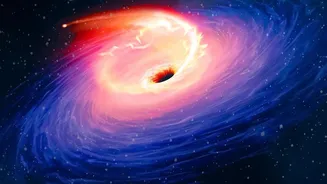
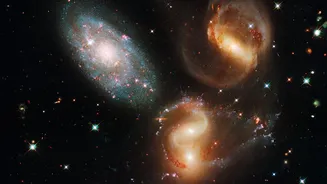
So, why is this discovery so important? It offers a direct look at a process that scientists have long theorised is crucial for cosmic growth: galaxy mergers. The leading theory is that large galaxies, like our own Milky Way, grew by colliding with and absorbing smaller ones over billions of years. When this happens, their central supermassive black holes should also eventually merge. J0148-4214 appears to be the result of at least three galaxies crashing together. Finding such a system in the early universe helps explain a major puzzle: how some supermassive black holes grew to be billions of times the mass of our sun so quickly after the Big Bang. These triple-merger events provide a fast track for black hole growth.
The Future: Gravitational Waves
The cosmic dance in J0148-4214 is far from over. The two central black holes are on an inevitable collision course, expected to merge in a few hundred million years. When they do, the event will be one of the most powerful in the universe, unleashing an immense blast of energy and sending ripples through the very fabric of spacetime. These ripples, known as gravitational waves, are a key prediction of Einstein's theories. While today's instruments cannot detect the low-frequency waves from supermassive black hole mergers, future space-based observatories like the Laser Interferometer Space Antenna (LISA) will be designed specifically for this task. Systems like J0148-4214 are the direct ancestors of the cataclysmic events LISA hopes to one day observe, making this discovery a vital link between our present observations and the future of astronomy.