





The Ghost Particle Mystery
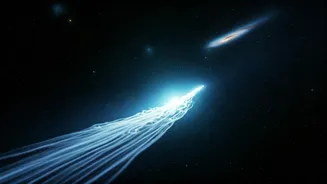
Neutrinos are fundamental subatomic particles, often called 'ghost particles' for their elusive nature. They have almost no mass, no electric charge, and they barely interact with any other matter in the universe. This allows them to travel billions of light-years
in a straight line from their source, carrying information from the most violent and distant cosmic events, like exploding stars or active black holes. While trillions of neutrinos from the Sun pass through your body every second, detecting the rare, high-energy ones from deep space is a monumental challenge that scientists have been tackling for decades. Successfully tracing them is like solving a cosmic crime by following a single, invisible clue across the cosmos.
A Telescope Made of Ice
To catch these ghosts, you need a very big net. Enter the IceCube Neutrino Observatory, a remarkable detector buried deep in the Antarctic ice. It isn't a telescope in the traditional sense; instead, it uses a cubic kilometre of pristine, clear ice as its medium. Over 5,000 light sensors are suspended on long strings within this massive ice block. On the rare occasion that a high-energy neutrino collides with an atom in the ice, it produces secondary particles that create a cone of blue light, known as Cherenkov radiation. The sensors detect this flash of light, allowing scientists to reconstruct the neutrino's energy and, crucially, the direction it came from.
Following the Cosmic Trail
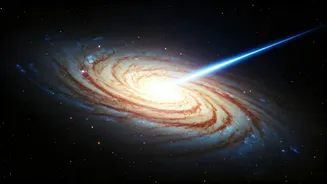
The headline-making breakthroughs in neutrino astronomy involve more than just a single detection. They represent the dawn of 'multi-messenger astronomy,' where observatories like IceCube work in tandem with traditional light-based telescopes. When IceCube detects a promising high-energy neutrino, it sends out an alert to astronomers worldwide. In a recent significant event, a neutrino detected in 2021, dubbed IC 210922A, was traced back to a specific patch of sky. While initial searches with optical and X-ray telescopes found nothing, a team eventually spotted an unusually bright object at longer wavelengths.
An Unexpected Culprit
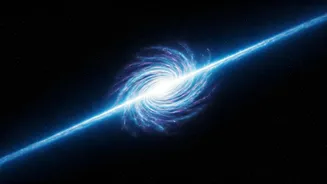
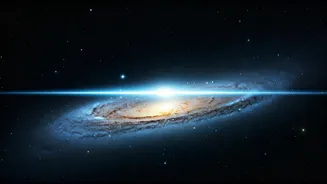
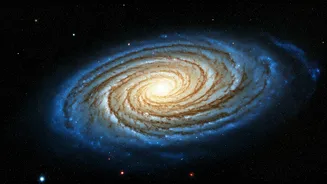
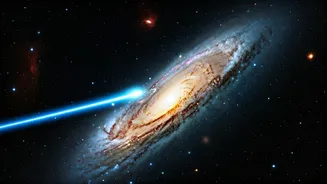
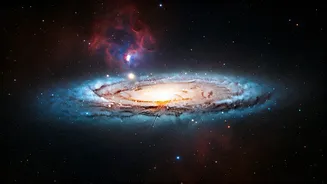
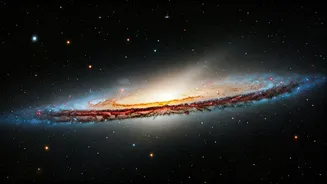
The source of this particular neutrino trail wasn't what many expected. Previously, the few identified sources of high-energy neutrinos were blazars—galaxies with supermassive black holes at their centres shooting out powerful jets of particles. But this time, the trail led to a galaxy nicknamed 'Shadow Blaster,' located roughly 11 billion light-years away. This galaxy is not powered by a black hole but is instead a 'starburst' galaxy, a place undergoing incredibly intense and rapid star formation. The galaxy is shrouded in so much dust that it's almost invisible to most telescopes, but its dense, chaotic environment is a perfect particle accelerator, creating the conditions needed to produce high-energy neutrinos.
A New Window on the Universe
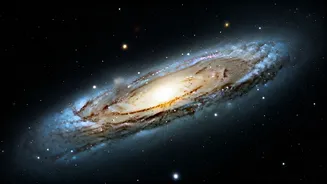
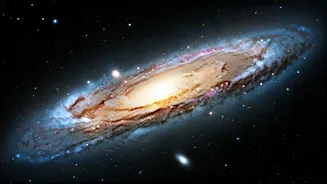
This discovery, linking a neutrino to a starburst galaxy, is a landmark moment. It suggests there's a whole new class of cosmic objects capable of producing these high-energy particles. Scientists estimate that dusty, star-forming galaxies like Shadow Blaster could be responsible for a significant portion of the total neutrino background that we detect. Beyond single sources, the IceCube observatory has also used data from tens of thousands of neutrinos to create the first-ever image of our own Milky Way galaxy using particles other than light. This new 'neutrino map' gives us a completely different way to see our galactic home, revealing processes that are hidden from conventional telescopes.