







The Journey So Far
The Gaganyaan programme is ISRO’s ambitious initiative to demonstrate human spaceflight capability by launching a crew of astronauts into a low-Earth orbit of 400 kilometres for a three-day mission and bringing them safely back to Earth. First announced
in 2018, the program has been in a phase of intensive development and testing. ISRO has successfully completed several key tests, including validation of the Crew Escape System, which is designed to protect astronauts in an emergency during launch. These preliminary successes have set the stage for the next and most crucial phase of the mission: a series of full-scale test flights.
First Hurdle: The Uncrewed G1 Mission
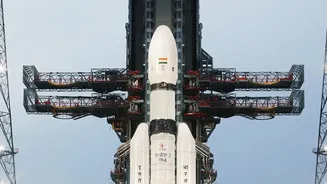
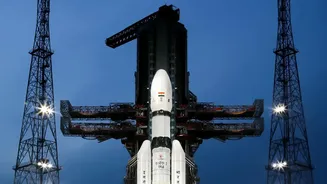
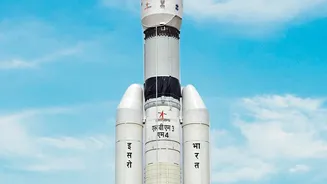
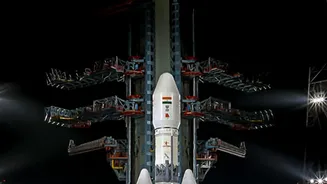
All eyes are on the first major uncrewed test flight, known as Gaganyaan-1 or G1, which is targeted for the last quarter of 2026. This mission is a full dress rehearsal without the astronauts. The spacecraft will be launched by the human-rated LVM3 rocket, India's most powerful launch vehicle. The primary goal of the G1 mission is to validate the performance of all systems in a real space environment, including the orbital module, propulsion systems, communication, and recovery operations. This flight will prove that the technology is sound and safe before any human life is on board. Astronaut safety remains the absolute top priority for the entire program.
Meet the Test Passenger: Vyommitra
The G1 mission won't be flying empty. Its passenger will be Vyommitra, a sophisticated humanoid robot developed by ISRO. The name is a combination of the Sanskrit words 'Vyoma' (space) and 'Mitra' (friend). Vyommitra is designed to simulate human functions during the flight. It can monitor key environmental parameters inside the crew module, like carbon dioxide levels, and operate switch panels. The data collected by Vyommitra on how the spacecraft's life support systems perform will be invaluable for ensuring the cabin is perfectly safe for the human crew on subsequent flights. Two more uncrewed missions, G2 and G3, are planned to follow G1 to complete the rigorous testing process.
The 'Gaganyatris' Preparing for History
Four Indian Air Force test pilots have been selected as the nation's first astronaut-designates, or 'Vyomanauts'. Group Captains Prasanth Balakrishnan Nair, Ajit Krishnan, Angad Pratap, and Shubhanshu Shukla were named in February 2024. They have already completed a comprehensive 13-month training regimen at Russia's Gagarin Cosmonaut Training Center and will resume advanced training in 2026, about a year before the crewed launch. This next phase will focus on mission-specific simulations and operational readiness. Their selection marks a pivotal moment, putting a human face to India's space ambitions and inspiring a new generation.
The Main Event: India's First Crewed Flight
Following the series of successful uncrewed tests, ISRO is targeting 2027 for the first crewed Gaganyaan mission, known as H1. This flight will carry three astronauts into orbit, making India the fourth country in the world—after the United States, Russia, and China—to independently send humans to space. The mission is planned to last about three days, after which the crew module will re-enter the atmosphere and splash down in the Indian Ocean, where recovery teams will be waiting. A successful H1 mission will be a landmark achievement, cementing India's status as a major spacefaring nation.
Beyond Gaganyaan: A Space Station and the Moon
Gaganyaan is not just a single mission; it is the foundation for India's long-term human spaceflight ambitions. Following the successful completion of the initial flights, ISRO plans to develop the Bharatiya Antariksha Station, India's very own space station, with the first module planned for launch by 2028. The long-term vision extends even further, with a goal to land an Indian astronaut on the Moon by 2040. These future goals depend on mastering the complex technologies and procedures being validated right now through the Gaganyaan programme.