




A Galactic Speed Bump
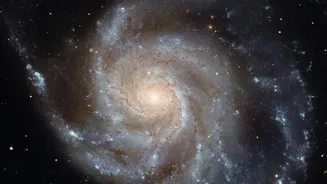
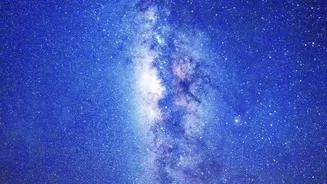
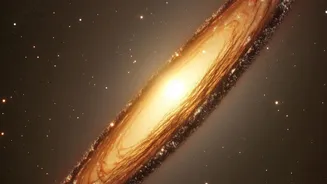
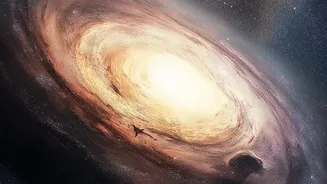
Our galaxy is a bustling metropolis of stars. At its core is a bright, dense bar, surrounded by a flat, spinning disk containing spiral arms like the one our Sun inhabits. Stars in this disk cruise at a brisk 220 kilometres per second or more. But beyond
this familiar structure lies a vast, sparse cloud of ancient stars called the stellar halo. For years, astronomers have been puzzled by this halo. Data from the European Space Agency's Gaia mission has confirmed that it rotates incredibly slowly, at a mere fraction of the disk's speed. This doesn't align with many cosmological models, which predict a much faster spin. It’s as if something put the brakes on the outer galaxy billions of years ago.
The Prime Suspect: An Ancient Collision
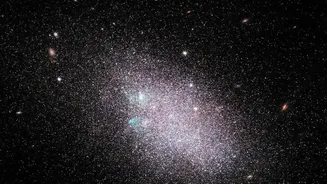
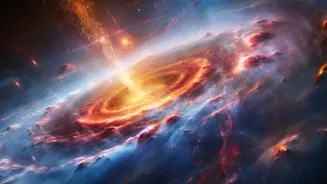
Scientists now believe they have identified the culprit: a dramatic, head-on collision with a dwarf galaxy that occurred between 8 and 11 billion years ago. This was no minor fender-bender; it was the most significant merger in our galaxy's formative years. The victim of this cosmic crash has been posthumously named Gaia-Sausage-Enceladus (GSE). The quirky name comes from the elongated, sausage-like orbits its leftover stars now follow as they weave through our galaxy. This ancient event was so transformative that its remnants can still be traced today, like a fossil record written in the stars. Astronomers have long known this merger happened, but its full consequences are only now being understood.
Flipping the Galactic Pancake
New research presented in July 2026 suggests this merger did more than just add new stars—it may have caused the entire Milky Way disk to flip. Using a sophisticated suite of supercomputer simulations called Auriga, a team of researchers from Durham University found a fascinating link. In their models, galaxies that experienced massive, head-on collisions like the GSE merger often underwent a dramatic reorientation, with their entire disk tipping by more than 90 degrees. This wasn't a sudden, rigid somersault. Instead, it was a gradual gravitational shift that unfolded over hundreds of millions of years, slowly scrambling the ordered rotation of the pre-existing stars and the incoming debris.
How a Crash Slows a Galaxy
The connection to the slow rotation lies in this violent re-shuffling. Before the merger, stars in the early Milky Way's disk likely had more orderly, circular orbits. The head-on collision with GSE, and the subsequent disk flip, threw everything into disarray. The orderly motion was converted into more random, chaotic energy. The gravitational forces involved in the merger effectively 'thermalized' the system, stripping stars of their prior orbits and redistributing them into the vast, puffed-up, and slow-spinning halo we see today. The simulations showed a clear pattern: the models that ended up with slow-rotating halos, just like our own Milky Way, were the ones that had experienced both a GSE-like merger and a major disk flip in their past.
Our Evolving Cosmic Home
This powerful new theory reshapes our understanding of our own galactic home. It paints a picture of the Milky Way not as a static, isolated island, but as a dynamic, evolving entity built from the wreckage of smaller galaxies. The same theory also suggests that the dark matter halo, an invisible structure that encompasses the entire galaxy, may have had its rotation slowed by the same event. This work highlights how astronomers can act as cosmic archaeologists, using the motions and chemistry of billions of individual stars to piece together a history that unfolded long before our planet even existed. What once appeared to be a puzzling anomaly now looks like a crucial clue to our galaxy's dramatic and violent youth.