



The Cosmic Misfits
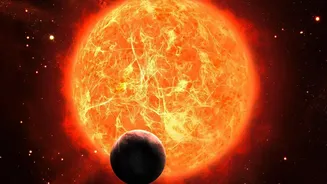
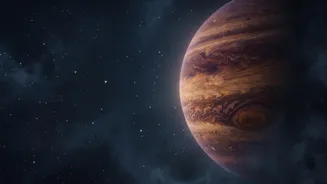
Imagine an object that forms like a star, from a collapsing cloud of gas and dust, but never quite makes it to the big leagues. That’s a brown dwarf. They are often called 'failed stars' because they don't accumulate enough mass to kick-start the nuclear
fusion of hydrogen in their cores, the process that makes stars like our Sun shine. Yet, they are far too massive to be considered planets, typically weighing in at 13 to 80 times the mass of Jupiter. This puts them in a unique celestial grey area. While they can't burn hydrogen, some can briefly fuse a heavier element called deuterium, which sets them apart from gas giants. After this initial burst of energy, they are destined to cool for the rest of their existence.
A Window into the Atmosphere
The key to understanding these 'in-between' objects lies in their atmospheres. Because many brown dwarfs float freely in space without a host star, they are much easier to study than exoplanets, which are often lost in the blinding glare of their suns. Using powerful tools like the James Webb Space Telescope (JWST) and the now-retired Spitzer Space Telescope, scientists can analyze the light that passes through or is emitted by a brown dwarf's atmosphere. This technique, known as spectroscopy, reveals the chemical fingerprints of the molecules and elements present, from water and methane to more exotic compounds. It allows researchers to create detailed 'weather maps' of these distant worlds, observing their clouds and storms from light-years away.
Cloudy with a Chance of Molten Iron
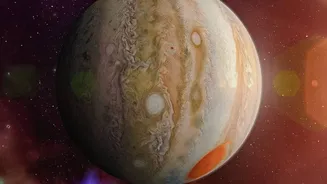
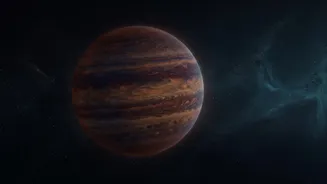
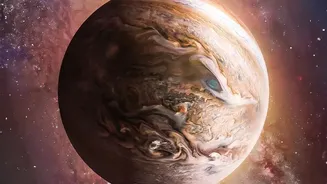
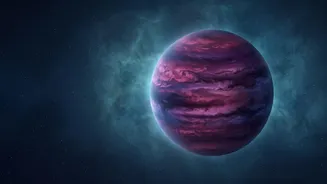
The weather on a brown dwarf is unlike anything in our solar system. Their atmospheres are home to powerful winds and vast, planet-sized clouds. But instead of being made of water like Earth's clouds or ammonia like Jupiter's, these clouds are composed of hot grains of sand, liquid iron droplets, and other vaporized minerals. At temperatures that can exceed 1,000 degrees Celsius, these silicate and iron clouds swirl in complex, multi-layered systems. Observations have shown that these cloud layers can change thickness rapidly, sometimes in the course of a single Earth day, causing the brown dwarf's brightness to vary as it rotates. This rapid variability points to dynamic and turbulent weather systems, more akin to the banded cloud structures of Jupiter than the chaotic boiling surface of a star.
Drawing the Great Divide
By studying these atmospheres, scientists are finding the clues needed to draw a clearer line between planets and stars. Brown dwarfs exhibit characteristics of both. Their formation from collapsing gas clouds is star-like, but their complex, cloudy atmospheres are very planet-like. Recent discoveries have pushed the boundaries even further. The JWST has identified brown dwarfs with masses as low as just two times that of Jupiter, challenging existing theories of star formation. Scientists have also found that as brown dwarfs cool over millions of years, they transition from having thick, dusty cloud cover to clear skies, a process that helps them understand how the atmospheres of giant planets evolve. The presence of specific molecules, like a unique hydrocarbon signature found only in the lowest-mass brown dwarfs, may even point to a new spectral class of object, distinct from both traditional stars and planets.
A New Cosmic Yardstick
Ultimately, brown dwarfs serve as a crucial bridge. Their planet-like weather, complete with wind-driven bands and clouds of rock, provides a natural laboratory for understanding the atmospheres of super-Jupiters found orbiting other stars. Because no two brown dwarfs seem to be exactly alike, even at similar temperatures, they showcase the vast diversity of celestial objects. By analyzing these 'failed stars', we learn more about the lowest-mass products of star formation and gain insight into the fundamental processes that shape both the largest planets and the smallest stars across our galaxy. They are no longer just misfits, but essential guides to understanding the cosmos.