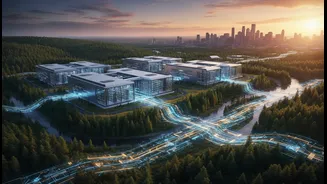










A New Digital Titan in Alberta
The scale of modern computing ambition is on full display in Sturgeon County, Alberta. In early July 2026, Meta, the parent company of Facebook, announced plans for what will be Canada's largest data center campus. The project represents a staggering
$13 billion investment aimed at creating a hub specifically designed for intensive artificial intelligence workloads. While the initial phase will connect to the grid, the full build-out of the campus is planned to reach a jaw-dropping 1,800 megawatts, or 1.8 gigawatts, of computing power, supported by a dedicated on-site power generation facility. This project alone signals a monumental step in establishing Canada as a premier destination for the world's most powerful technology companies.
Putting 1.8 Gigawatts in Perspective
A gigawatt is a term usually reserved for large-scale power plants, not individual commercial campuses. To put the 1.8 GW figure into perspective, the entire major city of Calgary consumes about 1.8 gigawatts of power. This single data center campus, at its full potential, could draw as much electricity as a metropolitan area of over one million people. This immense energy appetite is a direct result of the AI revolution. Training large language models and running complex AI applications requires tens of thousands of specialized, power-hungry graphics processing units (GPUs) operating around the clock. The heat generated also requires massive, energy-intensive cooling systems, making power capacity the single most important factor in site selection.
The Canadian Advantage: Power and Climate
So why Canada? The country offers a compelling combination of advantages for data center operators. For years, Quebec has been a magnet for the industry, attracting giants like Google, Microsoft, and Vantage Data Centers. The province's appeal is rooted in its abundance of clean, low-cost hydroelectric power and a naturally cool climate that significantly reduces the immense expense of cooling the servers. This combination of green energy and cost efficiency makes Montreal a top-tier data center market in North America. More recently, Alberta has entered the fray with a different strategy. The province is leveraging its energy expertise and a clear regulatory framework to help hyperscalers like Meta achieve the speed-to-market they require. By allowing for dedicated power generation on-site, Alberta is positioning itself as a place where the largest-scale AI ambitions can be realized quickly and reliably.
Economic Impact Beyond the Servers
These are not just server farms; they are massive economic engines. Meta's project in Alberta is expected to support 3,000 jobs during its construction phase and create 300 permanent high-tech roles once operational. The investment also includes tens of millions for local infrastructure upgrades, from roads to water systems. For municipalities, these developments diversify the local tax base away from traditional industries. Similarly, a recent 300-megawatt data center project announced by Bell in Saskatchewan is projected to create over 800 construction jobs and 80 full-time roles, highlighting the nationwide economic benefits of this digital infrastructure boom.
The Global Race for Computing Supremacy
Canada's data center boom is part of a frantic global race for digital real estate. As AI becomes foundational to nearly every industry, the tech giants are locked in a competition to secure the power and land needed to build their next-generation platforms. Estimates suggest that hyperscale companies could spend a combined total of US$700 billion on data centers in 2026 alone. Projects with capacities exceeding one gigawatt, once almost unthinkable, are now being announced in places like Texas, Arizona, and Wyoming. By successfully attracting these investments, Canada is ensuring it has a strategic seat at the table, providing the physical backbone for the AI-driven economy of the future.