





A Postcard from a Distant World
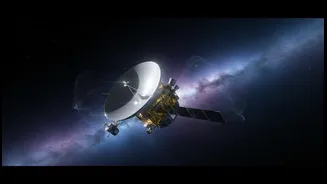
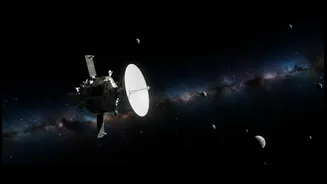
It’s easy to forget that just over a decade ago, Pluto was little more than a fuzzy dot in our most powerful telescopes. That all changed in July 2015, when New Horizons, after a nearly 10-year journey, sped past the dwarf planet. What it revealed was breathtaking.
Instead of a dead, inert ball of ice, Pluto was a world of stunning geological complexity. The probe discovered a vast, heart-shaped glacier of frozen nitrogen, named Sputnik Planitia, that is geologically young and appears to be in motion. It found towering mountains made of water ice, a hazy blue atmosphere, and signs that a liquid water ocean might exist beneath the frozen crust. The flyby fundamentally rewrote our understanding of worlds in the cold, distant reaches of the solar system, proving they could be dynamic and active.
The Most Distant Rendezvous
After its triumph at Pluto, the mission wasn't over. Mission planners had identified a second target, a tiny object in the Kuiper Belt a billion miles further out. On New Year's Day 2019, New Horizons executed the most distant flyby in history, imaging an object known as Arrokoth. This wasn't just another rock; it was a primordial relic from the birth of the solar system. The images revealed a strange, reddish, double-lobed object that looked something like a flattened snowman. Its shape suggested that it was formed from two separate bodies that gently spiraled toward each other and merged, rather than crashing violently. This provided crucial evidence for a long-debated theory of planet formation, suggesting a gentler process of accretion than previously thought. Arrokoth was a time capsule, perfectly preserved in the deep freeze of space for over 4.5 billion years.
The Solar System's Protective Bubble
With its two main flybys complete, New Horizons has a new, long-term objective: to study the heliosphere. This isn't a place you can land on, but a vast, invisible bubble that surrounds our entire solar system. It’s formed by the solar wind, a constant stream of charged particles flowing outward from the Sun at hundreds of kilometers per second. This bubble acts as a cosmic shield, protecting the planets, including Earth, from the harsh radiation of deep space, known as galactic cosmic rays. New Horizons is now travelling through the outer regions of this bubble, a place explored by very few spacecraft. Its instruments continue to measure the solar wind, dust, and energetic particles, providing a unique perspective from the solar system's remote frontier.
Chasing the Termination Shock
The next major milestone for the spacecraft will be crossing the 'termination shock'. This is the boundary where the solar wind, after traveling billions of kilometers, abruptly slows down to subsonic speeds as it begins to push against the interstellar medium—the gas and dust that fills the space between stars. Only NASA’s twin Voyager probes have crossed this boundary before. However, New Horizons is equipped with more advanced instruments, giving it the ability to make more sensitive measurements of this mysterious region. Scientists are using predictive models to estimate when this crossing will happen, with current projections placing it somewhere between 2029 and 2040. The boundary itself expands and contracts with the Sun’s 11-year activity cycle, making a precise date hard to pin down.
A Mission Reborn
Recently, the spacecraft woke from a 321-day hibernation period, a power-saving measure used during its long cruise phases. Though its main systems were dormant, several instruments continued to collect data on the outer heliosphere around the clock. Now awake and healthy at nearly 9.5 billion kilometers from Earth, it is beaming back this valuable information. While the team continues to search for another potential Kuiper Belt Object for a future flyby, the mission's primary focus has shifted. It now acts as a deep-space observatory, providing data that helps scientists understand the vast, comet-shaped structure of our solar system as it moves through the galaxy. With enough power to potentially operate into the 2040s, New Horizons is set to join the Voyager probes as humanity's third interstellar messenger.