


The Classic Tale of a Cosmic Crash
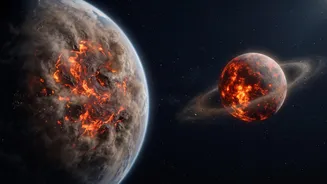
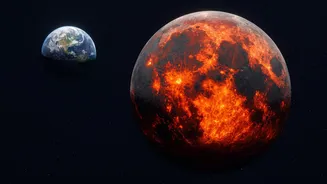
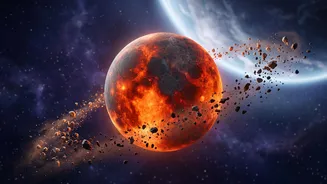
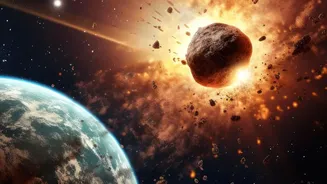
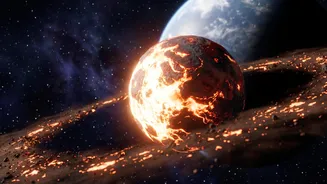
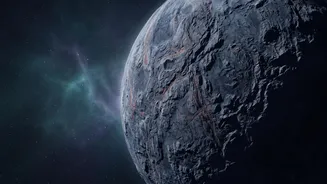
For decades, the most widely accepted story of the Moon's origin has been the Giant-Impact Hypothesis. The theory goes that about 4.5 billion years ago, a young, still-forming Earth was struck a glancing blow by a Mars-sized object named Theia. This cataclysmic
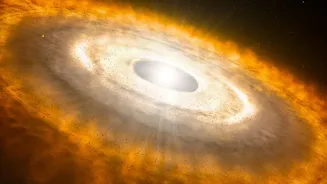
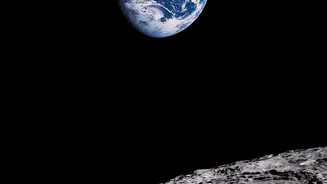
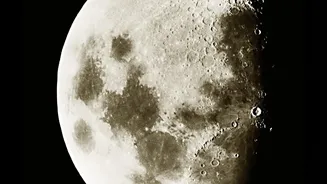
collision would have blasted a massive amount of molten rock and debris into space. According to this model, this material then formed a ring around our planet, which, over months or even years, gradually clumped together—or coalesced—to form the Moon we see today. This narrative has been the bedrock of lunar science, seemingly explaining key features like the Moon's size and orbit.
A Major Scientific Plot Hole
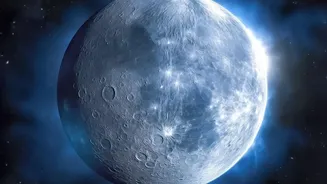
Despite its popularity, the classic Giant-Impact Hypothesis has a major flaw that has puzzled scientists for years. It's known as the isotopic crisis. In simple terms, if the Moon was mostly made from the debris of Theia, its chemical makeup should be distinctly different from Earth's. However, when Apollo astronauts brought back lunar rock samples, analysis showed a shocking similarity. The isotopic signatures of many elements, like oxygen, are virtually identical between Earth and the Moon. This suggests the Moon is made almost entirely of Earth material, a finding that directly contradicts models where most of the debris comes from the impacting body, Theia. This contradiction has sent scientists searching for a better explanation.
Rewriting the Story with Supercomputers
Enter the new theory: a faster, more violent birth. Using incredibly powerful supercomputers, researchers at institutions like NASA and Durham University have run simulations of the Earth-Theia collision at much higher resolutions than ever before. These advanced models have revealed a stunning new possibility. Instead of forming a debris disc that slowly coalesced, the impact could have been so forceful that it launched a large, partially molten chunk of Earth's own mantle directly into a stable orbit. This proto-Moon would have formed almost immediately—not over months or years, but in as little as a few hours.
A Moon in Mere Hours
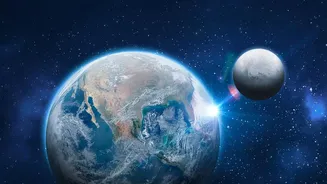
These new simulations, run on high-performance computing facilities like DiRAC, can model the collision using millions of particles, revealing details that lower-resolution models missed. The results show that under certain conditions of impact angle, speed, and planetary temperature, a Moon-sized satellite can emerge almost fully formed right after the collision. One recent study found that the physical properties of the colliding planets, such as their temperature and material strength, were crucial. A hotter, weaker Theia colliding with Earth could have resulted in a large, intact fragment being captured into orbit, forming the Moon in roughly five hours. This is a revolutionary departure from the idea of a slow and steady formation process.
Solving the Isotopic Puzzle
A rapid-formation scenario elegantly solves the isotopic crisis. If the Moon was born directly from material ripped from Earth's mantle, it makes perfect sense that their chemical compositions would be nearly identical. This new model suggests that the outer layers of the Moon, in particular, would be composed of material from the proto-Earth, which aligns with the evidence from lunar samples. While it doesn't solve every single mystery—such as the Moon's tilted orbit—it provides a much cleaner explanation for the striking chemical kinship between Earth and its satellite. The theory suggests a far more direct lineage, with the Moon being a true child of Earth rather than a distant cousin adopted after a cosmic smash-up.