


The Classic Cosmic Crash Story
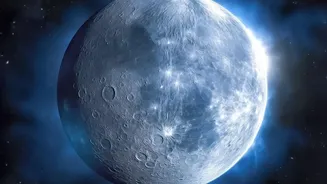
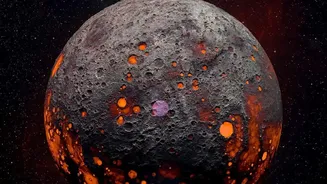
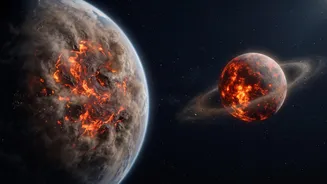
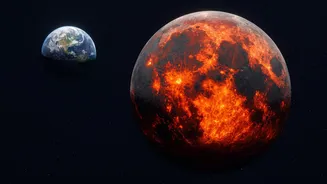
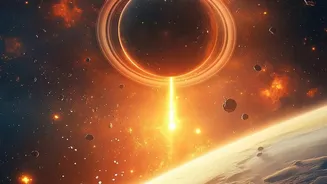
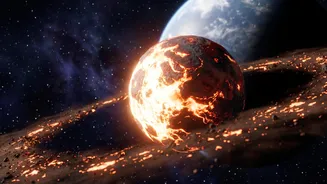
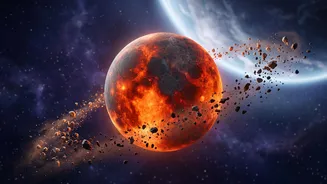
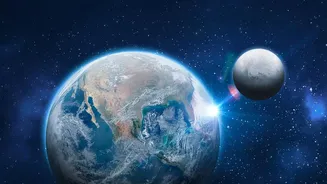
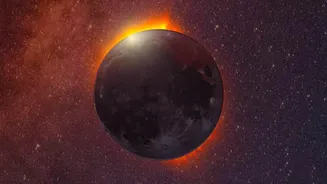
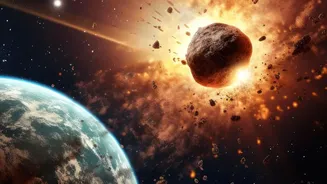
For decades, the leading scientific explanation for the Moon’s existence has been the “giant-impact hypothesis”. The story goes that about 4.5 billion years ago, a young, still-forming Earth was struck by a Mars-sized protoplanet named Theia. This cataclysmic
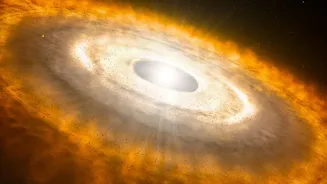
collision blasted a massive ring of molten rock, gas, and debris into orbit around our planet. Prevailing theories long held that this debris disk then slowly coalesced over months, years, or even longer, gradually clumping together under gravity to form the Moon we see today. This theory neatly explained many lunar mysteries, such as why the Moon’s composition is so similar to Earth's mantle and why it has a very small iron core. The Apollo missions brought back rock samples that supported this general idea, but the exact timeline remained a subject of debate.
A High-Speed Simulation Rewrites the Clock
Now, that timeline is being radically challenged. Researchers from institutions including NASA and Durham University have used incredibly powerful supercomputers to run new, higher-resolution simulations of the Earth-Theia impact. Previous models often treated the colliding planets as fluids, but these new simulations factored in their geologic properties and material strength, essentially treating them more like real, deformable rock. The results were astonishing. Under certain conditions, instead of forming a spread-out debris disk that takes ages to coalesce, the impact could launch a large, nearly-intact clump of material directly into a stable orbit. In some of these simulated scenarios, a proto-Moon formed in a matter of hours—as little as five, to be precise.
The All-Important Qualification
Here is the key qualification to keep in mind: this five-hour formation is a possibility, not a certainty. It represents one outcome from a range of complex simulations. The speed of the Moon's formation in these models depends heavily on a crucial, unknown factor: the initial temperature of Earth and Theia at the moment of impact. According to the new research, for the Moon to form this quickly, both celestial bodies would have needed to be extremely hot, making their outer layers softer and more prone to merging in a way that creates a single large satellite. If the planets were cooler and more brittle, the collision would have created a wider field of rocky debris, leading to the more traditional, slower formation process. Since we cannot know the exact temperatures from 4.5 billion years ago, the five-hour model remains a fascinating but unproven scenario.
Why a Faster Birth Matters
Whether the Moon formed in five hours or a thousand years has major implications for understanding its history and properties. A rapid formation event could better explain some long-standing lunar puzzles. For example, a body launched directly into orbit might explain the Moon's unusual tilted orbit relative to Earth. Furthermore, a faster birth could mean the Moon was not entirely molten in its infancy, which might align better with evidence suggesting it has a surprisingly thin crust. This new model also helps explain the Moon's Earth-like chemical signature, as a direct launch could trap more material from Earth's mantle in the outer layers of the newly formed Moon. It presents a whole new range of starting points for the Moon's evolution, changing how scientists think about its early days.