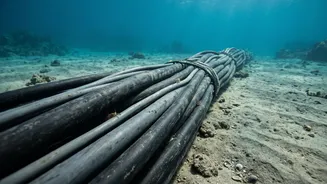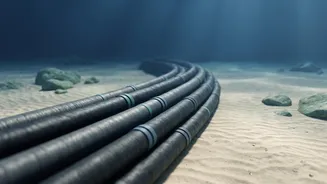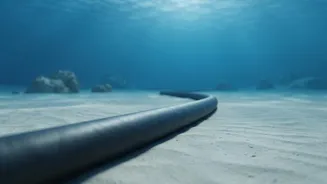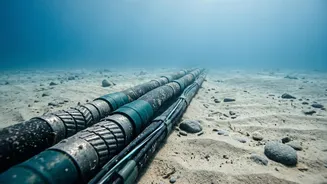




Every video you stream, every online payment, and every message you send travels through unseen highways on the ocean floor. But what happens when the heart of India's digital connection to the world is both geographically concentrated and slow to repair?
The Internet's Hidden Lifelines
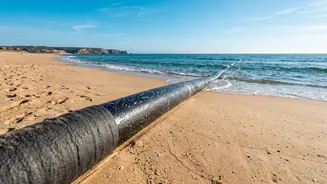
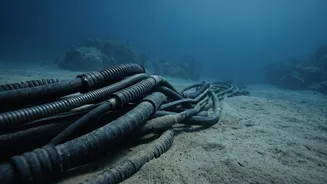
The internet is not a cloud. It is a physical network, and its backbone consists of approximately 600 submarine cables laid across the ocean floor, carrying around 95% of all international data traffic. These fibre-optic bundles are the lifeblood of the global economy, enabling everything from stock trades and cloud computing to video calls with family abroad. For a rapidly digitizing nation like India, which accounts for a significant portion of global data consumption, the resilience of this infrastructure is not just a technical issue—it's a matter of national strategic importance. Yet, despite its heavy reliance, India is connected to only about 3% of the world's subsea cables, creating a gap between its digital appetite and its physical infrastructure.
Mumbai's Critical Choke Point
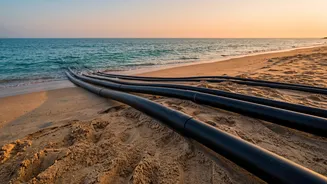
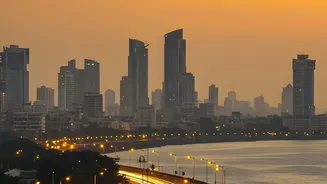
One of India's most significant digital vulnerabilities is located on a small, six-kilometre stretch of coastline near Versova in Mumbai. At least 13 of the nation's 18 intercontinental subsea cables come ashore in this single area. This extreme concentration means that this small patch of the Arabian Sea coast handles the vast majority—up to 95%—of India's data traffic heading west to Europe, Africa, and West Asia. Experts and industry bodies have repeatedly warned that this geographic clustering creates a critical single point of failure. An accidental event like a ship dragging its anchor, a natural disaster, or a deliberate act of sabotage in this one location could simultaneously sever multiple cables, potentially crippling a large portion of the country's international bandwidth for an extended period.
The Agonizing Wait for Repair
The risk is magnified by a second, equally critical problem: India has no domestically flagged or stationed vessels capable of carrying out deep-sea cable repairs. When a cable breaks, a specialized repair ship must be summoned from international hubs like Dubai or Singapore. This is where the bureaucratic bottleneck begins. Before a foreign vessel can even start work, it must navigate a complex and time-consuming clearance process involving multiple government agencies, including the Ministry of Defence and shipping authorities. This process can take weeks, if not longer. An analysis of the regulatory regime highlights several permit requirements, from security clearances for the vessel and crew to customs bonds, which can add significant delays and costs. This contrasts sharply with the monthly frequency of faults sometimes experienced at the busy Versova landing site.
A Digital Economy at Risk
A prolonged outage would have severe consequences. While the internet wouldn't vanish entirely, as data can be rerouted, speeds could plummet, impacting everything. Banking systems, stock markets, government networks, and the burgeoning AI and cloud service industries are all dependent on low-latency, high-bandwidth connections. The Telecom Regulatory Authority of India (TRAI) and other bodies have long recognized these vulnerabilities. Recommendations have been made to declare subsea cables as critical national infrastructure, which would help streamline approvals and protection. There are also growing calls to develop new cable landing stations in other cities like Visakhapatnam, Chennai, and Kochi to diversify risk and reduce the over-reliance on Mumbai. Recent government efforts to create a single-window portal for repair clearances, with a target implementation of March 2027, signal an awareness of the problem, but the underlying vulnerability remains.