




The idea of saving Earth from an asteroid often conjures images of a simple, powerful blast. But new research reveals a far more complex reality: where you hit it matters. A groundbreaking simulation from Sandia National Laboratories shows this nuance.
Beyond Perfect Spheres
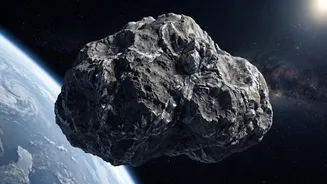
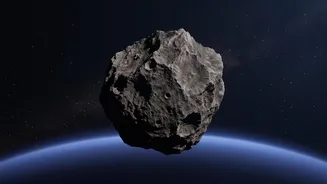
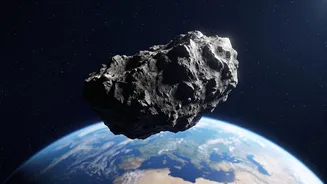
For years, scientists modeling planetary defense had to make a major simplification: they treated asteroids as perfect spheres. This made the incredibly complex calculations manageable, but it ignored a fundamental truth. As Sandia National Laboratories physicist Nathan Moore noted, 'spherical asteroids don't exist'. Real asteroids are lumpy, potato-shaped objects with uneven surfaces, ridges, and craters. Moore and his team developed a new computer model that, for the first time, could combine the realistic, irregular shapes of asteroids like Bennu and Golevka with high-fidelity physics calculations. This was made possible by a new algorithm over 1,600 times faster than previous methods, which were too slow to handle such complexity.
The Science of a Cosmic Nudge
The deflection strategy modeled by Sandia isn’t about blowing an asteroid to smithereens like in a Hollywood movie. Instead, the plan involves detonating a nuclear device at a standoff distance. The goal is to use the intense burst of X-rays from the explosion to flash-heat a thin layer of the asteroid’s surface. This superheated rock and dust instantly vaporizes and shoots off into space, creating a powerful jet of ejecta. Like the exhaust from a rocket engine, this outflow gives the massive asteroid a gentle but firm push in the opposite direction, nudging it onto a new, safer trajectory. This method focuses on deflection rather than destruction, which could create a cloud of smaller, still-dangerous fragments.
Why Aim Is Everything
The team’s simulations delivered a surprising result. While they expected the blast direction to have an effect, the magnitude of the difference was startling. For the same lumpy asteroid, hitting it from one side produced a deflection velocity nearly five times greater than hitting it from another. One simulated blast resulted in a change of 3.9 millimeters per second, while another angle only yielded 0.8 millimeters per second. The effect on the asteroid's rotation was even more dramatic. Depending on where the blast was aimed, the resulting spin imparted on the asteroid varied by a factor of 17. An uneven surface means the vapor jet doesn't push cleanly from behind; it can push from the side, turning a simple nudge into a complex spin that makes its future path harder to predict.
A New Toolkit for Planetary Defense
This breakthrough was achieved by cleverly combining two of Sandia's powerful simulation programs, ALEGRA and SPARTA. ALEGRA is typically used for high energy events, while SPARTA models weaker forces. By merging their capabilities, the team created a tool that could accurately model the entire deflection process on an irregularly shaped object. The practical implication is profound. 'Pick the right side and you win. Guess wrong and it could be a bad day,' Moore explained. Before this research, planners might have assumed a single, generalized outcome. Now, they have a way to test multiple scenarios, inputting an asteroid's specific shape to find the optimal point of impact to maximize the push while minimizing unpredictable spin. This transforms asteroid deflection from a brute force guess into a calculated, strategic science.