



The Growing Threat of Falling Debris
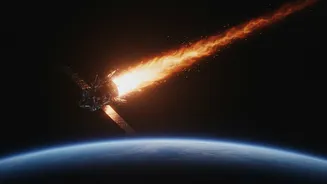
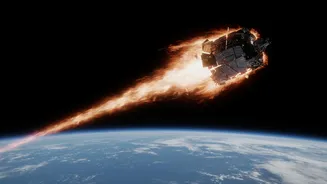
Every week, an average of two small, tracked objects re-enter Earth's atmosphere. While most of this hardware burns up due to the intense heat and friction generated at speeds of 28,000 km/h, some components are tough enough to survive. Recent incidents,
like a large metal rocket ring impacting farmland in Kenya, highlight the very real danger. Currently, space agencies consider an on-ground casualty risk of 1 in 10,000 as the acceptable threshold for any single uncontrolled re-entry. If the risk is higher, the satellite or rocket stage must be designed for a controlled re-entry, usually into an uninhabited area of the ocean, which adds significant cost and complexity to a mission. With the explosion of commercial satellite mega-constellations, the skies are getting more crowded, and the risk of uncontrolled re-entries is increasing.
Why Some Materials Survive
The problem lies in the materials used to build spacecraft. Components need to be incredibly strong and resilient to survive the violent forces of launch and the harsh environment of space. Unfortunately, these same properties often help them survive the fiery plunge back to Earth. Materials with high melting points, such as titanium, stainless steel, tungsten, and beryllium, are common culprits. Propellant tanks, engine components, and structural screws made from these metals can endure the extreme temperatures of re-entry and reach the ground. Even advanced composites like Carbon Fiber-Reinforced Polymers (CFRPs), prized for their strength-to-weight ratio, can pose a risk, as their complex breakdown process is not always predictable.
A New Philosophy: Design for Demise
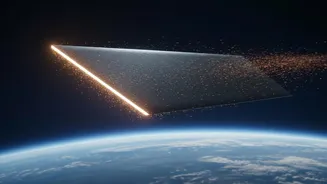
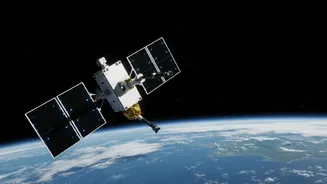
To counter this, space agencies and companies are embracing a new engineering philosophy known as 'Design for Demise' (D4D). The goal is to intentionally design hardware that is guaranteed to burn up, or 'demise', completely during an uncontrolled atmospheric re-entry. This approach is a key part of initiatives like the European Space Agency's (ESA) 'Clean Space' and 'Zero Debris' programs, which aim to make space activities more sustainable. By building satellites out of materials that reliably vaporise, operators can avoid the need for costly controlled re-entry manoeuvres and ensure that their missions don't leave a dangerous legacy on the ground.
The Science of Self-Destructing Materials
The search is on for materials that are strong in space but weak against atmospheric heat. The ideal demisable material has a low melting point and other specific thermal properties that encourage it to break apart and vaporise. One promising category is magnesium alloys. Alloys like Elektron 43 are not only significantly lighter than aluminium, which reduces launch costs, but they also have thermal properties that make them more likely to demise upon re-entry. Researchers are also exploring novel designs, such as creating structures with micro-lattices or engineering components to fragment early in the re-entry process, increasing their exposure to intense heat. Other strategies involve replacing problematic parts, like titanium screws, with alternatives made from more demisable metals.
Challenges on the Path to Cleaner Skies
Switching materials isn't as simple as it sounds. The aerospace industry relies heavily on 'heritage materials'—those with a long and proven track record of reliability in the extreme environment of space. Any new material must undergo rigorous and expensive qualification testing to prove it can perform its job flawlessly for years in orbit before it can be trusted. There is a constant trade-off between a material's structural integrity and its ability to demise safely. Furthermore, accurately simulating the complex physics of re-entry to predict how a new component will behave is a major challenge, requiring extensive ground testing and, eventually, in-orbit experiments to validate the models.