



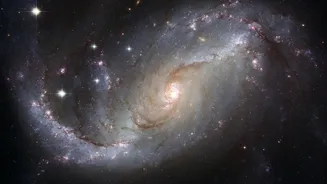
Our Closest Galactic Neighbor
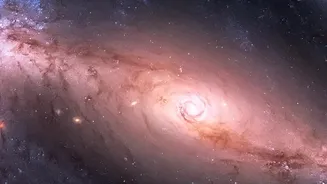
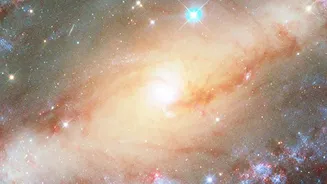
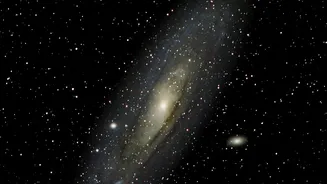
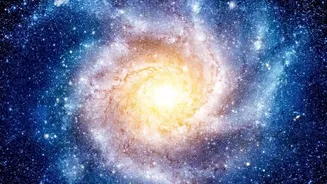
Just 2.5 million light-years away lies the Andromeda galaxy, or M31. To the universe, that's practically next door. It's the largest spiral galaxy in our local cosmic neighborhood, a sprawling city of an estimated one trillion stars, far more than our own
Milky Way. On a clear, dark night, you can spot it with the naked eye as a faint, fuzzy smudge in the sky—a whole other galaxy visible without a telescope. Its proximity and size make it the perfect laboratory for astronomers to study how large galaxies like our own form and evolve over billions of years. By watching Andromeda, we get a preview of the cosmic processes that shape our own galactic home.
The Fading Star Factories
The latest groundbreaking discovery is that Andromeda's star-making days are slowing down dramatically. A comprehensive study using years of Hubble data shows that star formation in the galaxy has been steadily declining for the past 500 million years. The drop has become even more pronounced in the last 40 million years. To put that in perspective, about 500 million years ago, Andromeda was churning out new stars at a rate of about one Sun's mass per year. Today, that rate has plummeted to just one-fifth of a solar mass annually. The galaxy isn't running out of the raw material—gas and dust—but its once-bustling star factories are entering a quiet retirement.
Hubble's Cosmic Time Machine
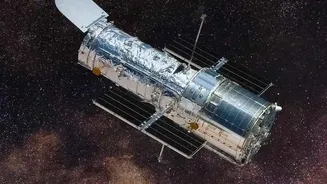
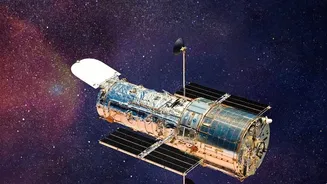
So how can we see history that happened millions of years ago? This is where Hubble's "long view" comes in. Astronomers used two massive surveys—the Panchromatic Hubble Andromeda Treasury (PHAT) and its southern counterpart, PHAST—to create an incredibly detailed map of Andromeda. They cataloged roughly 200 million individual stars. By studying the color of these stars, scientists can create a 'fossil record' of the galaxy's activity. Massive, young stars burn hot and blue but die quickly, while smaller, older stars glow redder and live much longer. By mapping where the blue and red stars are, astronomers can tell which regions have been recently active and which have been quiet for ages, effectively watching Andromeda's history unfold.
A Tale of Two Galaxies
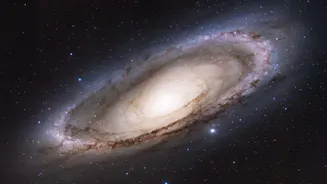
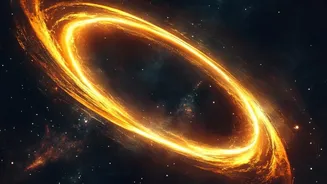
The study found that the decline isn't uniform. Much of the recent activity has been concentrated in a prominent ring about 32,000 light-years from the galaxy's center, and it is the fading of this ring that is driving the overall slowdown. This is part of a natural evolution, a wind-down after a more energetic youth. About 2 billion years ago, Andromeda likely experienced a massive burst of star birth, possibly from colliding with a smaller galaxy. Now, it's entering its cosmic middle age. Some researchers also suspect its small companion galaxy, M32, may have played a role in disrupting star-forming regions during a close pass. Our own Milky Way is still comparatively active, but this look into Andromeda's life cycle gives us a glimpse of our own potential future. However, there’s a massive plot twist on the horizon. In about 4.5 billion years, the Milky Way and Andromeda are predicted to collide and merge. This galactic crash won't destroy stars, which are too far apart to hit each other, but it will trigger a spectacular, galaxy-wide burst of new star formation, beginning the cycle all over again in a new, larger galaxy.