
A New Eye on Our Star
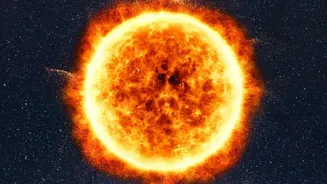
The groundbreaking image comes from the Daniel K. Inouye Solar Telescope in Hawaii, the world's largest solar observatory. While NASA is a key partner in solar research, the telescope is operated by the U.S. National Science Foundation. The new images
are so detailed they can resolve features as small as 20 kilometres on the sun's surface. This incredible resolution has allowed scientists to directly observe a phenomenon that was long theorized but never seen in such detail on the sun's surface: a process that creates mesmerizing swirls and vortices in the super-hot plasma.
Decoding the Plasma Swirls
So what are these swirling patterns? They are a textbook example of the Kelvin-Helmholtz instability. This occurs when two fluids moving at different speeds slide past each other, creating a shearing force that rolls up into waves and vortices. You've seen similar patterns on Earth in waving clouds or ocean swells. On the Sun, the 'fluids' are streams of magnetised plasma—electrically charged gas—on the star's visible surface, known as the photosphere. The images reveal these flower-like structures, with the finest details being the size of a large city, constantly churning and interacting. These are not just beautiful patterns; scientists believe these twisting motions build up and store magnetic energy, which can later be released in powerful solar explosions.
The Science of a Star's Surface
The Sun's surface is a complex and violent place, covered in bubbling convection cells of plasma called granules, each about the size of a state like Texas. Hot plasma rises in the bright centres of these cells, cools, and then sinks back down in the darker lanes between them. The new images show that the boundaries where these cells meet are incredibly dynamic, filled with the newly spotted swirls. Observing these small-scale events is crucial because they are the building blocks of much larger solar phenomena. Scientists hope that understanding how energy is transferred and builds up in these city-sized areas will help solve one of the Sun's biggest mysteries: why its outer atmosphere, the corona, is hundreds of times hotter than its surface.
Why Solar Weather Matters for Earth
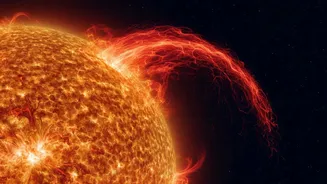
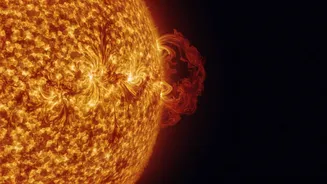
Studying the Sun isn't just an academic exercise; it has very real-world implications. The swirls and instabilities on its surface are linked to the mechanisms that power solar flares and coronal mass ejections (CMEs). These are massive eruptions of energy and particles that blast out into space, creating what is known as space weather. When this space weather hits Earth, it can have serious consequences. It can disrupt radio communications, damage satellites, knock out power grids by inducing currents in transmission lines, and pose a radiation risk to astronauts. Better understanding the fundamental physics of the Sun's surface allows for more accurate and timely space weather forecasting, giving us a better chance to protect our critical infrastructure.
Impact on India's Technological Ambitions
For a nation like India, which is rapidly expanding its technological and space-based assets, this research is particularly relevant. India's economy is increasingly reliant on a network of satellites for everything from communication and 5G services to navigation systems like NavIC, disaster management, and national security. All of these assets are vulnerable to the effects of extreme space weather. As India invests more in its space programme and digital infrastructure, the ability to predict solar storms becomes a matter of economic and strategic importance. Research that demystifies the origins of solar activity contributes directly to safeguarding these vital systems, ensuring that India's technological progress remains secure.