





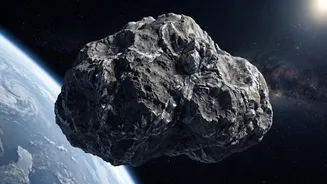
The threat of a civilization-altering asteroid impact feels like science fiction, but it's a real, if remote, possibility that scientists take seriously. New research from Sandia National Laboratories is refining how we might stop one in its tracks.
The Challenge of Hitting a Space Rock
Planetary
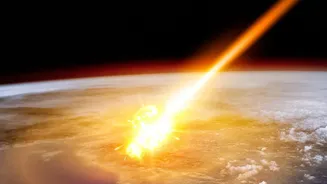
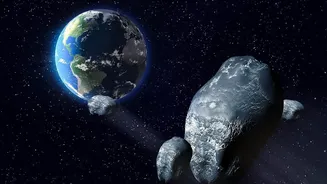
defense is the ultimate insurance policy. While small meteoroids burn up in our atmosphere daily as 'shooting stars', an encounter with a larger near-Earth object (NEO) could be catastrophic. For decades, scientists have been working on ways to find, track, and, if necessary, deflect a dangerous asteroid. One of the most studied methods is a kinetic impactor, where a spacecraft is intentionally crashed into an asteroid to nudge it off course. NASA's DART (Double Asteroid Redirection Test) mission in 2022 successfully proved this concept on the asteroid Dimorphos. But DART also revealed surprises, highlighting how much we still have to learn. Another powerful option, reserved for larger threats, involves using a nuclear device detonated near an asteroid. The intense blast of X-rays would vaporize part of the surface, creating a powerful push to alter its trajectory without shattering it into many smaller, equally dangerous pieces. The problem is, asteroids are not simple targets.
It's Not a Sphere
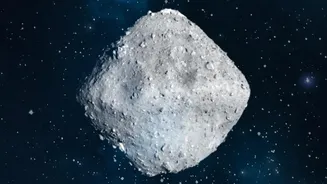
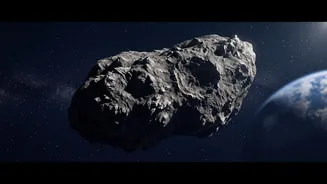
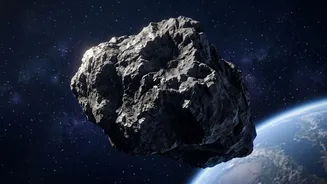
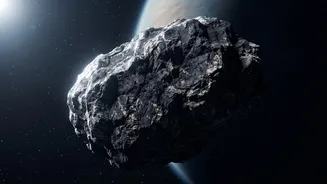
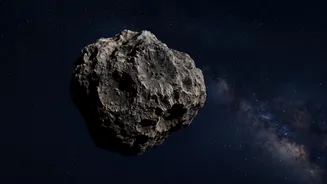
A persistent challenge in planning a deflection mission is that asteroids are not the perfect spheres often seen in old models. In reality, they are lumpy, irregular, and sometimes not even solid rock. Many are considered 'rubble piles'—loose collections of gravel and boulders held together by weak gravity. This makes predicting the outcome of any deflection attempt incredibly difficult. Hitting a solid boulder might have a very different effect than hitting a patch of loose gravel. Until recently, creating simulations that could account for both realistic, lumpy shapes and the complex physics of a high-energy blast was too computationally intensive. 'Most researchers were modeling asteroids like a sphere. It makes the math easier,' explained Sandia physicist Nathan Moore. 'The trouble is, spherical asteroids don't exist'. This is where Sandia's new research marks a significant leap forward.
A New Generation of Simulations
A team at Sandia National Laboratories, led by Moore, has developed a new modeling technique that is over 1,600 times faster than previous methods. This breakthrough allows them to combine high-fidelity physics with realistic, 3D asteroid shapes taken from actual spacecraft flybys of objects like Bennu and Itokawa. By merging two different simulation codes—one typically used for high-energy events and another for weaker forces—they created a tool that can accurately model how the X-rays from a nuclear burst would interact with an asteroid's uneven surface. These new simulations can calculate how much of the surface vaporizes, how hard the asteroid is pushed, how much it starts to spin, and whether the surface might break apart. The goal is a controlled push, not a chaotic fragmentation.
Why Aim Is Everything
The results of these new, more realistic simulations are startling. They reveal that for an irregularly shaped asteroid, where you aim the blast matters immensely. The team found that irradiating different sides of the same simulated asteroid could change the effectiveness of the deflection by nearly five times. In one case, the change in the asteroid's rotation speed varied by a factor of 17 depending on where it was hit. 'We expected aim to matter,' said Moore. 'What surprised us was how much'. These findings are critical for future mission planning. If an asteroid is heading for Earth, there might not be time for multiple attempts. Knowing its shape and being able to calculate the optimal point to target could be the difference between a successful deflection and a failed one.
Building a Library for Planetary Defense
This modeling work is part of a broader effort at Sandia to prepare for a potential asteroid threat. In separate experiments, researchers are using the powerful Z machine—the world's largest X-ray generator—to test how different materials react to intense bursts of energy. By suspending mock asteroid materials in a vacuum to simulate the free floating conditions of space they can gather real world data to validate and improve their computer models. The ultimate goal is to create a library of information that details how asteroids of varying compositions and shapes would react to different deflection attempts. This would give a future planetary defense team invaluable data allowing them to quickly choose the right strategy for a specific threat rather than scrambling to invent one when the clock is ticking.