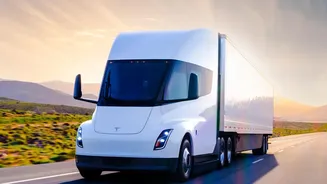








The Reality of the Rollout
When Tesla first unveiled its Semi in 2017, the logistics world took notice. With orders from giants like PepsiCo, Walmart, and UPS, the electric big rig was positioned as a game-changer. However, the path to mass production has been a long one. Initial
deliveries to its first major customer, PepsiCo, began in late 2022, but broader, high-volume manufacturing only officially commenced in April 2026. As of mid-2026, the total number of Class 7 and 8 battery-electric trucks registered across the US and Canada was still just a few thousand. While Tesla is a major player, its numbers are part of this small but growing pool, reflecting a market in its infancy rather than one it immediately dominates. The company aims to produce "many thousands" of Semis in 2026, with a long-term goal of 50,000 units annually from its Nevada factory, but the current on-road presence is a story of gradual beginnings, not an overnight takeover.
More Than Just the Truck
The primary hurdle for widespread adoption isn't just building the trucks; it's charging them. A heavy-duty electric truck requires a massive amount of power, far more than a passenger car. This necessitates a network of so-called 'Megachargers,' and building this infrastructure is a monumental task. While Tesla has installed these chargers at initial customer sites like PepsiCo's facilities, a public, cross-country network for commercial trucks is still in its early stages. Fleet operators can't invest in hundreds of trucks without guaranteed, reliable, and fast charging along their routes. This infrastructure dependency is a classic chicken-and-egg problem: truckers are hesitant to buy vehicles without a robust network, and building a network is only profitable when there are enough trucks to use it. This remains one of the single biggest practical barriers to electrification for heavy-duty fleets.
The View from the Fleet Manager's Office
For a commercial fleet manager, the decision to go electric is driven by a simple calculation: Total Cost of Ownership (TCO). While electric trucks promise significant savings on fuel and maintenance, they come with a much higher upfront purchase price. A diesel Class 8 truck can cost around $190,000, while early estimates for the Tesla Semi were significantly higher. Government incentives, like California's Hybrid and Zero-Emission Truck and Bus Voucher Incentive Program (HVIP), can dramatically lower this initial cost, making the math more attractive. In California, demand for these vouchers for the Tesla Semi has been strong, outpacing competitors combined. Still, for businesses operating on thin margins, the operational shift is a major consideration. It involves retraining drivers and mechanics, investing in on-site charging infrastructure, and planning routes around charging availability, all of which represent significant operational challenges.
A Crowded and Competitive Field
While Tesla captures much of the media attention, it is far from the only player in the electric truck space. Legacy manufacturers like Daimler Truck (with its Freightliner eCascadia) and Volvo (with its VNR Electric) have been actively deploying their own electric heavy-duty trucks. These companies have deep, long-standing relationships with commercial fleet operators and extensive service networks, giving them a significant incumbent advantage. Freightliner and Volvo have focused on regional and urban applications, which are currently more feasible given range and charging limitations. The market is seeing a split, with different manufacturers targeting different segments. While Tesla's performance claims, particularly on range, are ambitious, established brands are delivering vehicles and gaining real-world operational data with fleets today, creating a highly competitive landscape.
The Path Forward: Ramp-Up or Reality Check?
Despite the modest volumes to date, the future for the Tesla Semi is not bleak. Early results from PepsiCo's fleet have been positive, with drivers praising the vehicle's performance and the company reporting operational equivalence with diesel trucks on certain routes. The start of high-volume production in 2026 is a critical milestone, and significant new orders, such as a 370-truck deal with operator WattEV, show growing confidence. The key question for 2026 and beyond is the speed of the production ramp-up and the parallel buildout of the Megacharger network. The industry is growing rapidly, with analysts forecasting a compound annual growth rate of over 40% for the US electric truck market in the coming years. The attention the Semi has drawn is undeniable, but turning that attention into a commanding market share will depend entirely on execution.