

Meet Roman, Astronomy’s New Powerhouse
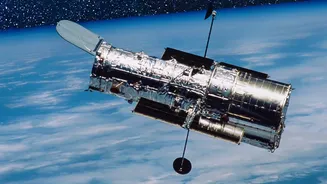
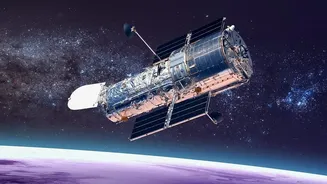
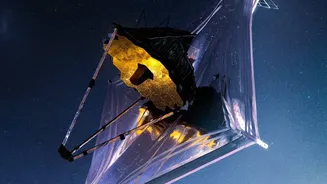
The Nancy Grace Roman Space Telescope is NASA's next-generation flagship observatory, named after the agency's first chief of astronomy. While telescopes like Hubble and Webb provide incredibly detailed, zoomed-in views of specific cosmic objects, Roman is built
for something different: panoramic scale. It has the same size primary mirror as Hubble (2.4 meters) and captures images with similar sharpness, but its main advantage lies in its enormous field of view. Its primary mission is not just to see the universe, but to survey it, creating vast maps that will help scientists tackle some of the biggest mysteries in astrophysics.
The Power of a Wide-Angle Lens
The key to Roman's efficiency is its primary camera, the Wide Field Instrument (WFI). This 300-megapixel camera can see a patch of the sky 100 times larger than Hubble's infrared instrument can in a single snapshot. Imagine taking a photo of a sprawling landscape. While Hubble might capture a single, beautiful tree in exquisite detail, Roman will capture the entire forest, the mountains behind it, and the river running through it, all in one go and with the same level of clarity. This capability allows Roman to survey the sky up to 1,000 times faster than Hubble. What would take Hubble years to map, Roman can accomplish in a matter of weeks, fundamentally changing the economics of cosmic data collection.
An Engine for Cosmic Discovery
This incredible survey speed is not just for creating pretty pictures; it's a scientific necessity. Roman is designed to investigate cosmic phenomena that are too large or too fleeting to be studied efficiently by other telescopes. Its two main targets are dark energy and exoplanets. To understand dark energy—the mysterious force causing the universe's expansion to accelerate—scientists need to map the positions and distances of hundreds of millions of galaxies. Roman's wide view is perfectly suited for this massive undertaking. For exoplanets, Roman will stare at the dense star fields in the center of our galaxy, watching for tiny, temporary brightening events caused by gravitational microlensing, a technique that can detect thousands of new worlds, including those much smaller or further from their star than other methods can find.
A Big Data Factory for the Cosmos
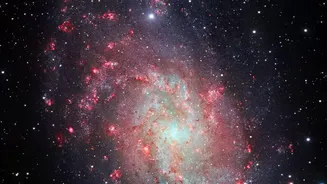
The sheer volume of information Roman will generate is staggering. It will measure light from a billion galaxies and is projected to discover thousands of exoplanets over its five-year primary mission. This transforms astronomy into a 'big data' science. Scientists will no longer be limited to studying a few hand-picked targets; they will have access to a vast, uniform dataset covering huge portions of the sky. This will enable statistical studies of the cosmos on an unprecedented scale, allowing researchers to spot trends and make discoveries that would be impossible with smaller samples. Roman's data will serve as a treasure map, identifying the most interesting targets for more focused follow-up observations by telescopes like the James Webb Space Telescope.