



Our Sun's Violent Outbursts
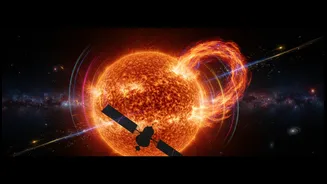
The Sun is not the perfectly serene ball of fire it appears to be. It is a dynamic star that periodically erupts, spewing enormous clouds of charged particles and magnetic fields into space. These events are known as Coronal Mass Ejections (CMEs). Often
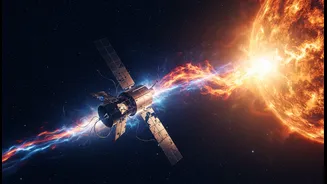
associated with solar flares—intense flashes of radiation—CMEs are like cosmic hurricanes. A CME can hurl billions of tonnes of solar material at speeds of thousands of kilometres per second. While most of these storms miss Earth entirely, a direct hit can have profound consequences for our technologically dependent civilization. The recent Drishti incident serves as a stark reminder of this vulnerability, prompting a closer look at the very real risks posed by space weather.
How Solar Storms Wreak Havoc
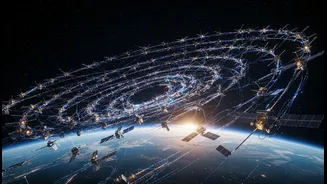
When a CME collides with Earth's magnetic field, it can trigger a geomagnetic storm with a range of disruptive effects. For satellites in orbit, the danger is threefold. First, a flood of high-energy particles can damage or destroy sensitive electronics, corrupt data, and degrade solar panels, effectively shortening a satellite's lifespan. This radiation can cause 'phantom commands', where the satellite acts erratically. Second, the storm heats Earth’s upper atmosphere, causing it to expand. This increases atmospheric drag on satellites in low-Earth orbit, slowing them down and causing their orbits to decay. In a notable 2022 incident, a relatively minor storm caused the loss of up to 40 newly launched Starlink satellites due to this increased drag. Finally, the build-up of plasma can lead to electrostatic discharges, essentially a short circuit on the satellite's exterior that can damage its systems.
A Cycle of Increasing Risk
The Sun's activity follows a roughly 11-year cycle, moving from a quiet solar minimum to a turbulent solar maximum. We are currently in Solar Cycle 25, which began in 2019. While initially predicted to be a weak cycle, activity has ramped up much faster and more intensely than forecasted. The peak of this cycle, the solar maximum, has brought a significant increase in the frequency and strength of solar flares and CMEs. This means we are now in a multi-year window of heightened risk. Events that might have seemed like science fiction, such as the 1859 Carrington Event which set telegraph offices on fire, are a modern-day possibility with far more devastating potential.
The Threat to India's Digital Backbone
For a nation like India, which has rapidly embraced a digital-first economy, the stakes are incredibly high. Our daily lives run on a complex web of interconnected technologies that are vulnerable to space weather. A severe geomagnetic storm could disrupt GPS and the homegrown NavIC navigation systems, impacting everything from aviation and shipping to ride-sharing apps. The telecommunications network, crucial for everything from phone calls to disaster response, could face blackouts. Perhaps most concerning is the threat to the financial system. Banking operations, stock markets, and the Unified Payments Interface (UPI) system all rely on precise timing signals from satellites and stable power grids, both of which are at risk during a major solar storm.
Watching the Sun, Protecting Our Future
The threat is serious, but we are not powerless. The key to mitigation is early warning, and this is where India's space program is playing a crucial role. The Indian Space Research Organisation's (ISRO) Aditya-L1 mission is the country's first dedicated solar observatory. Positioned 1.5 million kilometres from Earth at a strategic location called Lagrange Point 1 (L1), Aditya-L1 has an uninterrupted view of the Sun. Its suite of instruments is designed to study the Sun's atmosphere, analyse the origin of CMEs, and monitor the solar wind. The data it provides is vital for understanding space weather and giving us precious hours or days of warning before a storm hits. This allows satellite operators to put spacecraft into a protective 'safe mode' and for power grid managers to prepare for potential impacts. These efforts are not just scientific endeavours; they are essential for safeguarding our national infrastructure and economic security.