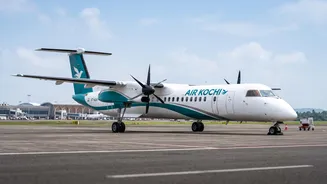









The Kerala government has given its approval for a novel proposal: an airline owned and operated by the people, for the people. This ambitious plan aims to launch India's first-ever airline in the co-operative sector, a move that could reshape regional
travel.
An Answer to High Airfares
For years, Keralites, particularly the large non-resident community in the Gulf, have faced steep and often unpredictable airfares. The dream of a state-backed airline to counter this has been a long-standing one, with projects like 'Air Kerala' proposed as far back as 2005 but never fully taking flight. This new initiative, tentatively named 'Co-Keralam', emerges from the same aspiration: to provide affordable and reliable air connectivity. The plan is spearheaded by the Kerala Civil Aviation Development Cooperative Society, with the government's approval marking a significant step forward for a concept that has been discussed for nearly two decades. The announcement, made by Chief Minister V. D. Satheesan, positions the venture as a testament to the strength and potential of Kerala's robust co-operative movement, which is expanding beyond its traditional domains of banking and agriculture.
The Co-Operative Model Explained
Unlike privately owned carriers or the state-owned Air India, a co-operative airline operates on a principle of collective ownership. The proposed funding model for Co-Keralam is inspired by the success of Cochin International Airport (CIAL), which was built with public-private participation. The plan is to raise capital by having around 200 co-operative societies in the state invest ₹2 crore each, potentially generating a starting fund of ₹400 crore. This structure means the airline will be owned by its member societies and, by extension, the people they represent, without direct financial investment from the state government. This approach aims to create a business that is directly accountable to its stakeholders and community. The project is being led by C.N. Vijayakrishnan, a prominent figure known for his leadership at the MVR Cancer Centre and the Calicut City Service Cooperative Society.
What 'Government Approval' Means
The Chief Minister's announcement signifies a crucial 'in-principle' approval from the state government, granting permission for the co-operative sector to enter the aviation industry. This is a green light for the promoters to proceed with the complex process of launching an airline. However, it's important to note this is just the first step. The project must still navigate the rigorous regulatory landscape of Indian aviation, which includes securing an Air Operator Certificate (AOC) from the Directorate General of Civil Aviation (DGCA). The government's backing provides political and moral support, but the operational and financial viability rests on the co-operative's ability to meet these stringent national standards. Details on a firm launch timeline and final regulatory clearances are still forthcoming.
Initial Plans and Towering Hurdles
According to initial proposals, Co-Keralam plans to begin with a modest fleet of two leased 72nd seater aircraft based out of Kochi. The focus will be on regional connectivity, linking Kochi with other destinations within Kerala like Kozhikode and Kannur, and nearby cities in neighbouring states, including Bengaluru, Chennai, and Coimbatore. Proposed fares are projected to be in the range of ₹3,500 to ₹7,000. While the vision is compelling, the path ahead is fraught with challenges. The Indian aviation market is notoriously difficult, marked by intense competition from dominant players like IndiGo and the Tata Group's airlines, volatile fuel prices, and significant operational costs. India's aviation history is filled with examples of airlines that have struggled to remain profitable, even with massive capital. The success of Co-Keralam will depend on navigating these economic pressures and the complex web of aviation regulations.