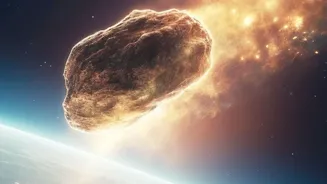






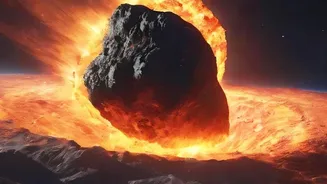
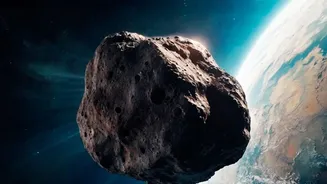
Successfully nudging a dangerous asteroid away from Earth might be more complicated than just hitting it hard. New research shows that where you hit it matters immensely, with an asteroid's uneven shape causing wildly different outcomes.
A Landmark Test in the Cosmos
Humanity's first
real-world test of planetary defense, NASA’s Double Asteroid Redirection Test (DART), was a resounding success. In September 2022, the vending-machine-sized spacecraft intentionally slammed into Dimorphos, a small moonlet asteroid, millions of miles from Earth. The goal was to see if a 'kinetic impactor' could alter an asteroid's path. The collision worked even better than expected, shortening Dimorphos's orbit around its larger parent asteroid, Didymos, by 33 minutes—far exceeding the minimum success target of 73 seconds. This proved the basic concept: we can, in fact, change the motion of a celestial body. But the data from that impact opened up a new, more complex set of questions about how to best apply this technique if a real threat ever emerges.
Not Just a Giant Rock
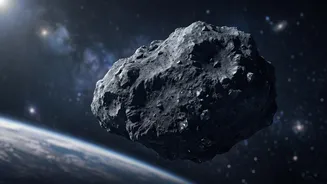
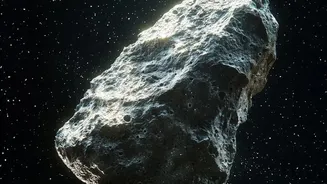
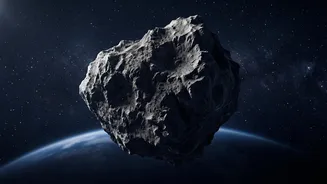
A critical detail revealed by the DART mission and others, like the OSIRIS-REx mission to asteroid Bennu, is that many asteroids are not solid, monolithic boulders. Instead, they are 'rubble piles'—loose collections of rocks, gravel, and dust held together by their own weak gravity. This structure fundamentally changes how an object reacts to an impact. Hitting a solid rock is predictable; hitting a pile of gravel is not. The DART impact on Dimorphos ejected tons of asteroidal rock into space, and this spray of debris created a recoil effect that provided a much larger push than the spacecraft's impact alone. This confirmed that an asteroid's composition is a major factor, but the next question was just as important: what about its shape?
Where You Hit It Matters, A Lot
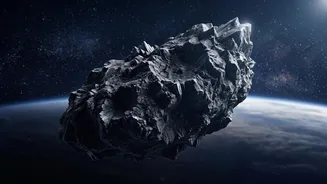
This is where the new modeling comes in. Recent simulations led by physicists at Sandia National Laboratories have explored how an asteroid's irregular, lumpy shape affects a deflection attempt. Previous models often simplified asteroids as perfect spheres to make the calculations manageable. However, using a new, much faster algorithm, researchers can now incorporate realistic 3D asteroid shapes taken from actual flyby missions, like those of asteroids Bennu and Itokawa. The results were startling. The simulations, which modeled the effects of a stand-off nuclear blast that vaporizes the asteroid's surface to create a push, showed that the effectiveness of a deflection could vary by nearly five times depending on which side of the asteroid was targeted. Hitting one side of a simulated asteroid produced a deflection velocity of 3.9 millimeters per second, while hitting another side produced a change of just 0.8 millimeters per second.
The Challenge for Planetary Defense
This discovery has major implications for future planetary defense strategies. It's no longer enough to simply plan for an impact; mission planners must now account for the target's specific topography. A blast or impact on a protruding ridge might just spin the asteroid or break off a piece with little effect on its overall trajectory. A hit on a flatter, more concave area could provide a much more efficient push. For one simulated asteroid, the change in its rotation speed varied by a factor of 17 depending on the direction of the blast. This means that before launching a deflection mission, a detailed reconnaissance of the target asteroid would be critical. We would need to create a full 3D map of its shape to identify the optimal point of impact. This adds a significant layer of complexity and time to any potential defense scenario, emphasizing the need to spot threatening objects as early as possible.