







A Vision from the Mughal Empire
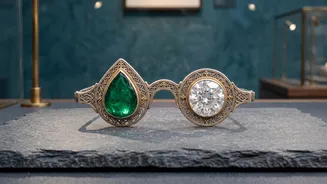
The heart of this extraordinary object lies in its lenses, which date back to the 17th century, the height of the Mughal Empire in India. But these are no ordinary lenses; they are fashioned from two flat, drop-shaped pieces of emerald. Experts believe
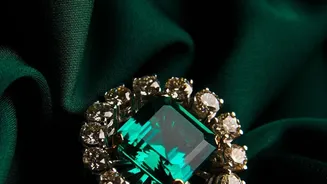
they were sliced from a single, colossal Colombian emerald that may have originally weighed over 300 carats. In Mughal culture, gemstones were not just for adornment; they held deep spiritual significance. Emeralds, with their vibrant green hue, were associated with paradise, healing, and salvation, giving the spectacles their poetic name, Astaneh-Ye Ferdaws, or “Gate of Paradise”. Commissioned by an unknown but undoubtedly powerful Mughal prince or emperor, the belief was that looking through these green gems could aid spiritual enlightenment.
The Colombian Emerald Connection
The journey of the emerald itself is a story of global trade. The raw stone was mined in Colombia, likely from the famed Muzo mines, and transported across the Atlantic by Spanish or Portuguese merchants. From there, it made its way to the Mughal court, a testament to the empire’s immense wealth and its rulers' passion for the world's finest gemstones. The task of slicing such a significant gem into perfectly matched, paper-thin lenses without shattering it required incredible mastery. This feat of lapidary art produced lenses not for correcting vision, but for filtering the world through a divine green light.
A 19th-Century Makeover
For two centuries, the emerald lenses existed in a different form, likely as part of a more traditional pince-nez style ornament. Around the 1890s, they were given a new lease on life. The spectacles were refashioned into their current form, set into elegant gold and silver frames decorated with rose-cut and brilliant-cut diamonds. This upgrade reflects the changing tastes of the time, when Indian nobility and maharajahs began embracing European styles and commissioning lighter, more intricate settings for their traditional gems. The 19th-century frames, believed to be the work of a master craftsman like Alfred André, transformed the ancient lenses into a wearable object that blended Mughal legacy with contemporary fashion.
A Twin in Diamond
The “Gate of Paradise” spectacles do not stand alone. They have a companion pair known as Halqeh-e-Nur, or “Halo of Light.” These spectacles feature lenses fashioned from diamonds, believed to have been cleaved from a single stone of 200 to 300 carats from the legendary Golconda mines in India. Like its emerald counterpart, the “Halo of Light” was also fitted with a diamond-encrusted frame in the 19th century. Together, the two pairs represent one of the most remarkable surviving examples of Mughal jeweled artistry, showcasing the empire's reverence for both emeralds and diamonds as stones of power and spiritual importance.
A Treasure for the World
These unique spectacles have captivated collectors and art lovers for years. In 2021, both the “Gate of Paradise” and “Halo of Light” were put up for auction by Sotheby's in London, with pre-sale estimates reaching into the millions of dollars. While they did not sell at the live event, their emergence brought renewed attention to their incredible history. These objects are now part of the Al Thani Collection, a vast and encyclopedic assemblage of art from across global civilizations, founded by Sheikh Hamad bin Abdullah Al Thani. Highlights from this collection are on long-term display at the Hôtel de la Marine in Paris, allowing the public to witness these marvels firsthand.