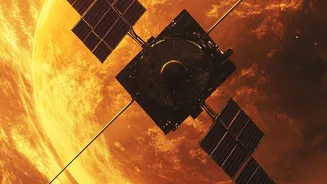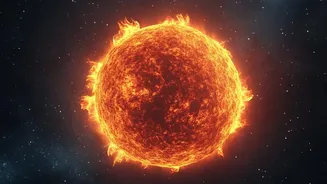


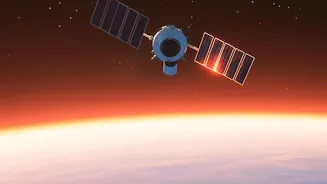

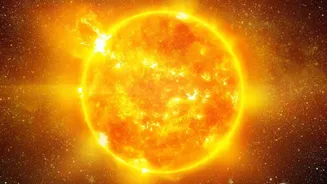
India’s eye on the Sun, the Aditya-L1 observatory, has uncovered a fascinating solar secret. New research shows a powerful solar eruption didn't expand evenly like a perfect bubble, but grew asymmetrically.
The Sun's Fiery Breath
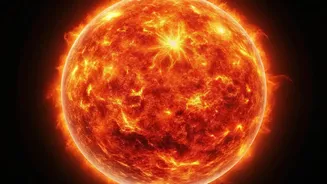
Our Sun is not always the calm, steady star it
appears to be. It frequently unleashes colossal explosions of magnetised plasma known as Coronal Mass Ejections, or CMEs. These are among the most powerful events in our solar system. For a long time, scientists have often modelled these eruptions as symmetrical bubbles, expanding uniformly in all directions as they race through space. This assumption made it easier to predict their path and potential impact. However, this simplified model was based on observations that couldn't see the full picture, primarily capturing the two-dimensional movement of CMEs across the sky. But science, like the universe, is rarely that simple. A new finding from ISRO is challenging this long-held view.
A Lopsided Explosion
In a study focusing on a specific CME event observed on August 5, 2024, scientists from the Indian Institute of Astrophysics (IIA) in Bengaluru made a groundbreaking discovery using data from Aditya-L1. They found that this particular solar eruption did not expand uniformly. Instead, it grew asymmetrically, stretching and changing shape as it travelled away from the Sun. It was a lopsided explosion, expanding unevenly from its point of origin. This crucial detail was uncovered by combining Aditya-L1's unique observational capabilities with data from other sources and advanced 3D computer modelling. The team at IIA demonstrated that a model assuming a tilted structure and uneven sideways expansion perfectly matched the data, whereas a uniform-expansion model could not.
Aditya-L1's Unique View
So, how did Aditya-L1 see what previous missions struggled to? The key lies in its primary instrument, the Visible Emission Line Coronagraph (VELC). Unlike traditional coronagraphs which mainly take 2D images, VELC is a spectrograph. It can measure the 'Doppler shift' of the light emitted by the plasma in a CME. This is similar to how a traffic speed gun works. By analysing shifts in the light's frequency, scientists can determine whether plasma is moving towards us (a blueshift) or away from us (a redshift). During the August 2024 event, VELC detected plasma moving in both directions simultaneously, a clear signature of a complex, three-dimensional, and asymmetric eruption that simple imaging alone would miss. This provided the 'third dimension' to the observation, revealing the eruption's true, uneven shape.
Why This Discovery Matters for Earth
This discovery is more than just a fascinating piece of solar physics; it has significant practical implications for us on Earth. CMEs are the primary drivers of severe space weather. When directed at our planet, they can disrupt satellite operations, GPS navigation, communication networks, and even cause damage to power grids. Predicting when a CME will arrive and how strong it will be is crucial. The shape of a CME affects how it travels through space and interacts with the constant stream of particles from the Sun, known as the solar wind. An asymmetrically shaped eruption might experience different drag forces, altering its speed and trajectory in ways that simpler models can't predict. By understanding that these eruptions are not perfect spheres, scientists can build more accurate and sophisticated forecasting models, giving us a better chance to prepare for potentially disruptive solar storms.