




Two Missions, One Star
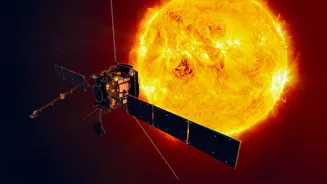
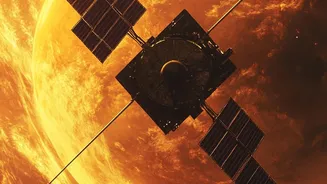
Aditya-L1 is India's first dedicated solar observatory, a landmark mission for ISRO. Stationed 1.5 million kilometres from Earth at a special vantage point called Lagrange Point 1 (L1), it has an uninterrupted view of the Sun. Its main goal is to study
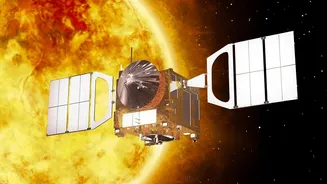
the Sun's atmosphere, from the chromosphere to the corona, and understand phenomena like coronal heating and solar wind. On the other side of this partnership is Proba-3, a highly innovative mission from the European Space Agency (ESA). Proba-3 is the world's first precision formation-flying mission. It consists of two separate satellites flying in a tight, controlled formation about 150 metres apart. This unique setup allows one satellite to block the Sun's bright face, creating a near-perfect artificial eclipse for the other satellite to observe the faint, mysterious corona.
The Danger of Solar Eruptions
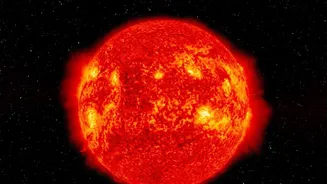
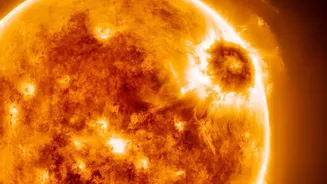
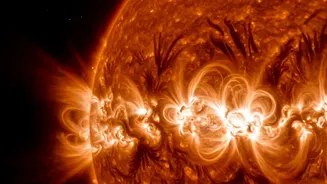
The Sun's outer atmosphere, the corona, is a chaotic place. It frequently unleashes colossal explosions of plasma and magnetic fields called Coronal Mass Ejections, or CMEs. These are not just beautiful cosmic events; when directed at Earth, they can be incredibly disruptive. CMEs can trigger powerful geomagnetic storms that threaten our modern way of life. They can damage or disable crucial satellites used for communication and navigation, disrupt power grids leading to widespread blackouts, and pose a radiation risk to astronauts in space. For decades, scientists have struggled to study CMEs in their earliest moments. The Sun's overwhelming glare makes it difficult to see these eruptions as they form close to the solar surface, leaving critical gaps in our understanding of how they accelerate and what makes them so powerful.
A Cosmic Tag Team in Action
This is where the synergy between Aditya-L1 and Proba-3 becomes a game-changer. Neither mission could achieve this alone, but together, they provide a multi-dimensional view of solar eruptions. Proba-3's formation flying creates a long-lasting, high-quality artificial eclipse, allowing its coronagraph, ASPIICS, to capture incredibly detailed images of the inner corona where CMEs are born. It essentially provides a crisp, close-up picture. Simultaneously, Aditya-L1's Visible Emission Line Coronagraph (VELC) observes the same region, but from its unique L1 vantage point. VELC uses a different technique called spectroscopy, which analyses the light to determine the temperature, velocity, and density of the plasma within the eruption. By combining Proba-3's sharp imaging with Aditya-L1's detailed plasma diagnostics, scientists can construct a 3D model of a CME as it unfolds.
Measuring the Unmeasurable
For the first time, researchers have combined data from both missions to analyse the same CMEs, as detailed in a recent study in the journal 'Astronomy & Astrophysics'. This joint analysis allows them to calculate fundamental properties of an eruption that were previously just estimates: its total mass, density, and the distribution of its energy. Understanding these figures is crucial. The mass and speed of a CME determine its kinetic energy—how powerful a punch it will pack. The density and temperature tell scientists about the physical processes driving the explosion. By cross-checking the data from both spacecraft, which use different methods, scientists gain much higher confidence in their measurements. This leap from flat, 2D images to a comprehensive 3D understanding marks a new era in solar physics.
A Landmark for Global Science
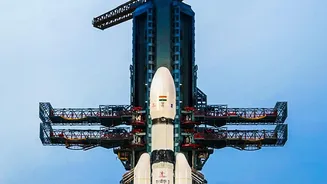
The Aditya-L1 and Proba-3 collaboration is more than just a scientific success; it's a testament to the power of international partnership in space exploration. It showcases ISRO's growing prominence on the global stage, not only for its independent mission capabilities but also as a key collaborator in cutting-edge science. Interestingly, the collaboration is multi-layered, as ISRO's own reliable PSLV rocket also launched the ESA's Proba-3 mission into orbit. This joint effort between India and Europe provides deeper insights into solar physics than either agency could have achieved on its own. It demonstrates a shared global commitment to understanding phenomena that affect all of humanity and paves the way for more ambitious international space science projects in the future.