



A Cosmic Disappearing Act
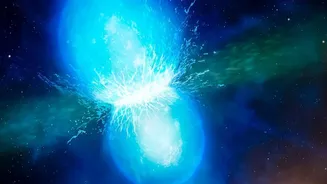
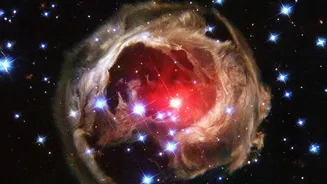
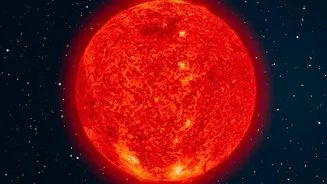
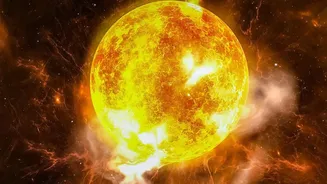
For decades, there has been a discrepancy in our cosmic accounting. Astronomers' models predict that a certain number of massive stars, specifically red supergiants, should end their lives in brilliant, violent explosions called supernovae. Yet, when
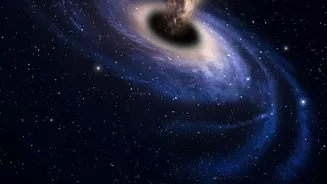
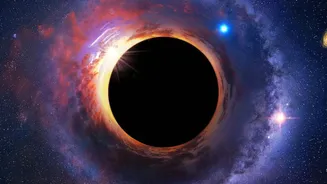
they look out into the universe, they find fewer of these explosions than expected. It’s as if some of these colossal stars are simply blinking out of existence, bypassing the grand finale. These events are often called “failed supernovae,” where the star's core collapses directly into a black hole without the typical bright explosion. This has been a significant mystery, suggesting a gap in our understanding of how the most massive stars die.
The Ghost Particle's Role
Enter the neutrino, one of the most elusive and strangest particles in the universe. Often called “ghost particles,” neutrinos are produced in staggering numbers during the final moments of a massive star's life as its core implodes under its own gravity. They are nearly massless and interact so weakly with other matter that trillions pass through your body every second unnoticed. For a long time, scientists thought that while neutrinos carry away about 99% of the energy from a collapsing star, their specific behaviour was a side detail. However, new research is challenging that assumption, placing these phantom particles at the very heart of a star's ultimate fate.
Simulating Stellar Death
A recent study led by researchers at the University of Copenhagen’s Niels Bohr Institute has provided a compelling new piece of the puzzle. The team ran 195 computer simulations of stellar collapses, modeling stars with masses ranging from nine to 120 times that of our Sun. The crucial new element in these simulations was a phenomenon called “neutrino flavor conversion.” Neutrinos come in different types, or “flavors,” and can switch between them. Previously, this was thought to have a negligible effect on the star's explosion. The new simulations, however, found that where and when these flavor changes occur can dramatically alter the outcome.
Explosion or Collapse?
The study revealed that including neutrino flavor conversion in the models made it significantly more likely for a massive star to skip the supernova and collapse directly into a black hole. This was especially true for stars between 16 and 30 times the mass of the Sun. Essentially, the way neutrinos change their identity inside the dying star's core can be the deciding factor between a spectacular explosion and a quiet disappearance. A small change in the behavior of these tiny particles can determine whether the universe witnesses a brilliant supernova or the silent birth of a black hole. This could be the mechanism that explains the missing red supergiants and why we observe fewer supernovae than our theories predict.
What This Means for Astronomy
These findings could reshape our understanding of the end-of-life evolution of massive stars. According to Mariam Gogilashvili, a lead author of the study, neutrinos are not a minor detail; they are central to the entire process. If this model holds true, it not only explains the phenomenon of vanishing stars but also has other implications. For instance, it could help explain why astronomers have detected neutron stars with lower masses than theories previously predicted. The behaviour of neutrinos could be the hidden variable that connects many different astronomical observations. The next step for researchers is to incorporate these more realistic models of neutrino behavior into even more complex, three-dimensional simulations of massive stars to refine these groundbreaking insights.