



Powering Through the 14-Day Night
One of the biggest hurdles to a long-term lunar presence is power. The Moon endures a roughly 14-day long night, rendering solar panels useless for half a month. To solve this, NASA is aggressively pursuing Fission Surface Power systems. These are small,
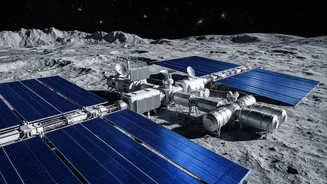
modular nuclear reactors that can provide a steady, reliable power source regardless of sunlight. NASA plans to have its first reactor, the Lunar Reactor-1 (LR-1), on the Moon by 2030, capable of generating enough electricity to power dozens of homes continuously for years. This technology is the cornerstone of building a functional base, as it will energize life support, scientific experiments, and resource processing around the clock. Vertical solar arrays on tall masts are also being developed to catch the low-angle sun at the poles, complemented by regenerative fuel cells for energy storage.
Living Off the Land with Moon Dust
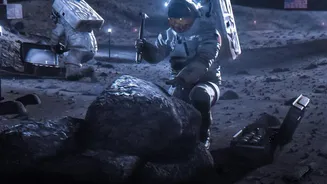
The cost of launching every single resource from Earth is astronomical. The solution is to 'live off the land' through a concept called In-Situ Resource Utilization (ISRU). This involves harvesting and processing local materials. At the lunar south pole, a key target for the Artemis missions, there are permanently shadowed craters believed to hold vast quantities of water ice. This ice can be mined and processed to provide breathable air and drinkable water. It can also be split into hydrogen and oxygen, the primary components of rocket propellant, potentially turning the Moon into a refueling station for missions deeper into space. NASA is developing robotic missions and excavators, like the ISRU Pilot Excavator (IPEx), to map and prove these resource extraction technologies.
Building Habitats with 3D Printers
Instead of shipping heavy habitat modules, future lunar inhabitants may 3D-print their homes using the very ground beneath their feet. The loose soil and dust on the Moon's surface, known as regolith, is rich in silicates and minerals. Researchers are developing methods to melt or bind this regolith into a durable construction material, essentially creating 'lunar concrete'. Experimental projects have already demonstrated the ability to 3D-print interlocking, LEGO-like bricks from simulated moon dust. These structures would provide excellent shielding from the harsh radiation and extreme temperature swings on the lunar surface. This approach drastically reduces launch mass and allows for the construction of larger, more permanent structures like landing pads, habitats, and protective berms.
Next-Generation Mobility and Communication
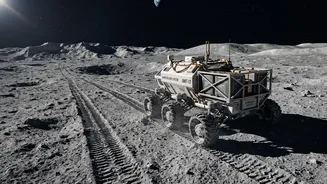
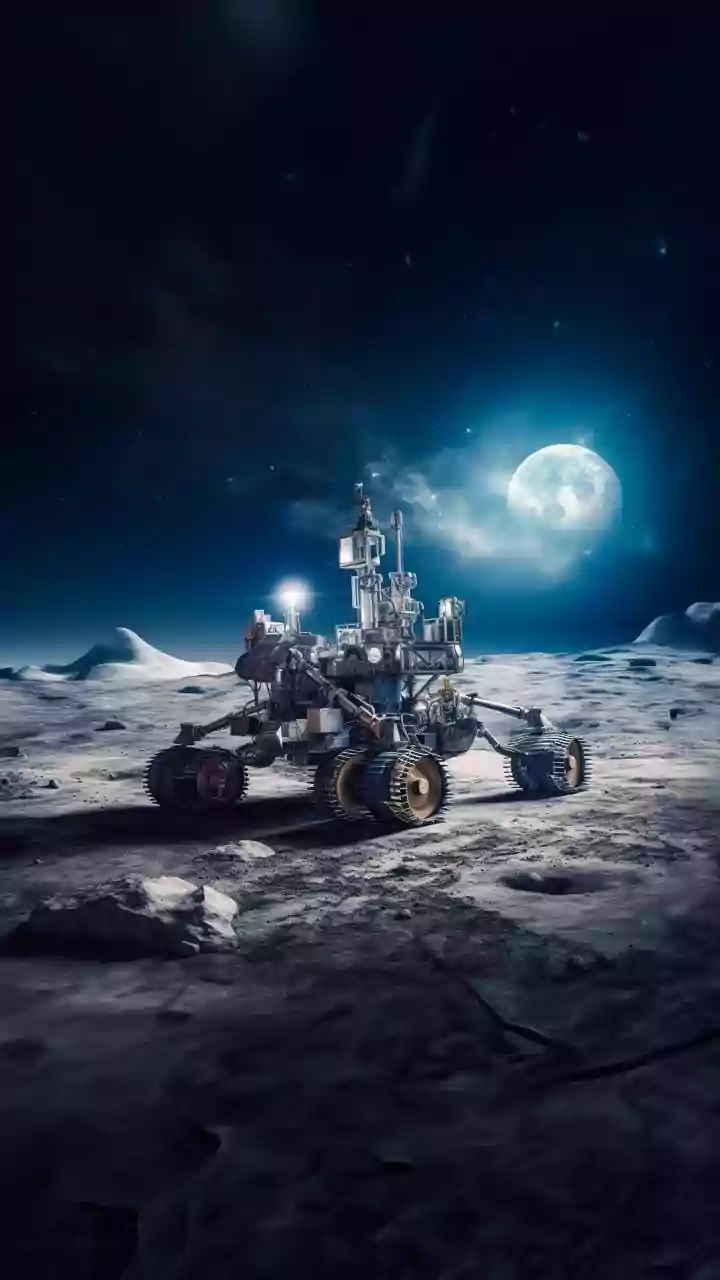
Exploring the Moon requires more than just footprints. NASA and its commercial partners are developing a new generation of vehicles to expand astronaut range and capability. These include unpressurized buggies, known as Lunar Terrain Vehicles (LTVs), for shorter trips in spacesuits. For longer journeys, pressurized rovers are being designed that will act as mobile habitats, allowing astronauts to conduct multi-day science expeditions far from the main base. To support this sprawling presence, a robust communications network is essential. NASA is planning to deploy a network of lunar satellites, similar to SpaceX's Starlink, to provide continuous high-speed communication between the Moon, lunar orbit, and Earth. Drones are also planned to help scout and monitor the area around the base camp.