





1. The 2021 Chamoli Disaster, Uttarakhand
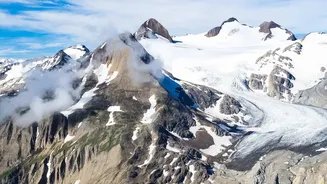
On a February morning, a colossal wedge of rock and glacier ice broke off from Ronti Peak. This initial avalanche, containing nearly 27 million cubic metres of material, was just the first domino. As it thundered down the valley, friction generated immense
heat, melting the ice and transforming the avalanche into a fast-moving, incredibly destructive debris flow. This secondary event, a slurry of water, mud, and boulders the size of cars, barrelled down the Rishiganga and Dhauliganga river valleys. It obliterated two major hydropower projects and led to the tragic loss of over 200 lives, demonstrating how a rockfall could instantly trigger a deadly flood.
2. The 2013 Kedarnath Tragedy, Uttarakhand
This event is remembered as one of India's worst natural disasters, a clear case of compounding hazards. The trigger was unusually intense rainfall between June 13 and 17, which would have been dangerous on its own. This deluge, however, fell on melting snow, creating the perfect conditions for landslides. The immense volume of water caused the Chorabari glacial lake to breach its natural dam, unleashing a torrent down the Mandakini river. The combination of the initial cloudburst, the subsequent glacial lake outburst flood (GLOF), and widespread landslides created a catastrophic flood wave that devastated the Kedarnath valley, resulting in thousands of deaths.
3. The 2023 Sikkim Floods
In early October 2023, the South Lhonak glacial lake in North Sikkim was already in a precarious state due to climate-driven melting. The chain reaction began when a massive, unstable section of frozen rock and debris collapsed into the lake. This generated a tsunami-like wave that breached the lake's dam, unleashing half its volume—equivalent to 20,000 Olympic swimming pools—downstream. This GLOF became a cascading disaster as it travelled down the Teesta River, triggering 45 secondary landslides and destroying the 1,200 MW Teesta-III hydropower dam, amplifying the destruction far downstream.
4. The 2015 Gorkha Earthquake, Nepal
The primary hazard was the powerful M7.8 earthquake that struck Nepal, causing immense devastation and nearly 9,000 fatalities. However, the initial ground shaking was just the beginning. The seismic waves triggered thousands of secondary hazards across the mountainous terrain. These included massive landslides that blocked roads and rivers, hampering rescue efforts and creating new flood risks. The quake also triggered deadly avalanches on Mount Everest and in the Langtang Valley, where hundreds went missing. This event showed how a single geophysical shock can simultaneously set off numerous other deadly hazards over a vast area.
5. The 2012 Seti River Flood, Nepal
For weeks, a series of rockfalls had been tumbling into the deep Seti River gorge, creating a natural, unstable dam. The situation escalated dramatically when a massive ice and rock avalanche broke free from the slopes of Annapurna IV. The force and friction of this avalanche generated hurricane-force winds and melted snow, creating a surge of water and debris. This surge overwhelmed the temporary rock dam, causing it to burst. The result was a sudden, violent debris flow that swept through downstream villages, killing 72 people who had little to no warning, a stark example of a landslide triggering a dam-break flood.
6. The August 2026 Nepal-Tibet Border Floods
A devastating event along the Nepal-Tibet border highlighted how hazards cross borders. Preliminary analysis suggested that the disaster began with a glacier-rock avalanche in the Langtang mountain region of Tibet. This initial event generated a high-energy debris flow that travelled down the Bhote Koshi–Trishuli river system into Nepal. As the flood moved, it grew in destructive power, picking up more sediment and boulders. This event was not caused by heavy rainfall or a traditional GLOF, but by a slope failure that cascaded into a transboundary flood, illustrating the complex and interconnected nature of risk in the region.
7. The 2016 Bhote Koshi Flood, Nepal
Originating in Tibet as the Poiqu Chu, the Bhote Koshi river descends an extremely steep gradient, making it prone to extreme events. In July 2016, a major flood caused severe damage in Nepal's Tatopani region. This was not a simple monsoon flood but a cascading event with transboundary origins. An initial hazard event in China—likely a landslide or the breach of a temporary lake—sent a pulse of water and debris downstream. This event highlighted how disturbances high in a river's catchment can have devastating consequences far downstream and across national borders, a common feature in the interconnected river systems of the Himalayas.