


Living Monuments of Engineering
More than just charming relics, three of India's mountain railways are collectively recognised as a UNESCO World Heritage Site. The Darjeeling Himalayan Railway, the Kalka-Shimla Railway, and the Nilgiri Mountain Railway are celebrated as "outstanding
examples of bold, ingenious engineering solutions" for traversing rugged, mountainous terrain. Built during the British Raj in the 19th and early 20th centuries, these lines were crucial for connecting remote hill stations, which served as summer capitals and trade hubs, to the plains. Today, they stand as living museums, preserving not only the heritage of steam and diesel locomotion but also the cultures that grew around them. Their slow pace, a stark contrast to modern life, allows passengers to immerse themselves in landscapes of breathtaking beauty.
Darjeeling's Pioneer: The First Toy Train
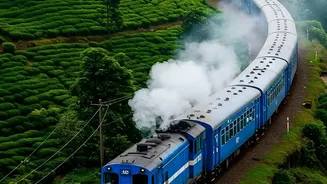
The story begins with the Darjeeling Himalayan Railway (DHR), the first and arguably most famous of the trio, which began operations in 1881. Its 2-foot narrow-gauge track covers 88 kilometres from New Jalpaiguri to Darjeeling, ascending over 7,000 feet. To conquer the steep gradients, engineers devised a brilliant system of six zig-zags and five loops, including the famous Batasia Loop, which offers a stunning panoramic view of Darjeeling and the snow-capped Kanchenjunga peak. Riding the train, which still operates some of its original B-Class steam locomotives, is a sensory experience. The engine whistles past bustling market towns, colourful houses built inches from the tracks, and verdant tea gardens that carpet the hillsides, making the journey as iconic as the destination itself.
The Kalka-Shimla Express: A Passage Through the Hills
Completed in 1903, the Kalka-Shimla Railway was built to connect the plains with Shimla, the former summer capital of British India. This engineering marvel stretches over 96 kilometres and is renowned for its staggering number of architectural features. The journey takes passengers through 102 active tunnels, across more than 860 bridges, and around 919 sharp curves. Some bridges, like the multi-tiered arch gallery bridge number 226, are magnificent structures that span deep valleys. The longest tunnel, at Barog, is over a kilometre long and has its own tragic tale of a humiliated engineer. The leisurely five-hour ride offers ever-changing vistas of pine forests and the Shivalik foothills, allowing travellers to appreciate the immense effort required to build this vital link to the 'Queen of Hills'.
Nilgiri's Blue Gem: The Steepest Track in Asia
In the south, the Nilgiri Mountain Railway (NMR) offers a completely different, yet equally spectacular, experience. Opened in 1908, it connects Mettupalayam with the popular hill station of Udhagamandalam, or Ooty. What makes the NMR unique is its use of the 'Abt' rack and pinion system, the only one of its kind in India. This technology, involving a toothed rack rail between the tracks that meshes with a cogwheel on the locomotive, allows the train to climb Asia's steepest railway gradient at 1 in 12.5. The vibrant blue carriages are pushed by a classic steam engine on the steepest sections, travelling through 16 tunnels, over 250 bridges, and past dense forests and tea plantations of the Nilgiri Hills, a UNESCO World Heritage site in its own right.