





The Cosmic Potato Problem
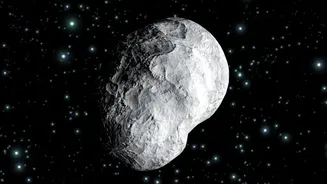
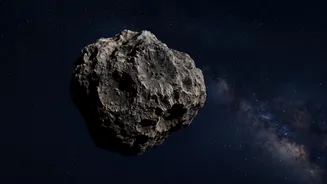
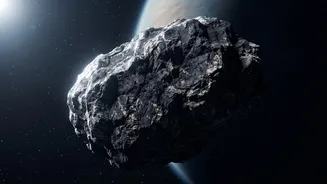
Most asteroids aren't the clean, spherical objects we imagine. They are more like cosmic potatoes: lumpy, oblong, and asymmetrical. For decades, scientists modeling asteroid behavior often simplified them as spheres to make the complex physics manageable.
This was a necessary shortcut, but it left a major question unanswered: how does the real, irregular shape of an asteroid affect its movement, especially after a sudden event like an impact or a defensive blast? Recent research highlights that many asteroids are not solid bodies but 'rubble piles'—loose collections of rock and dust held together by their own weak gravity. This structure, combined with their irregular shapes, makes them behave in incredibly complex ways when disturbed.
Simulating a Planetary Defense Scenario
To tackle this question, a new study led by researchers at Sandia National Laboratories developed a highly advanced computer model. Instead of using spheres, they created detailed 3D models of asteroids based on real radar observations and spacecraft flybys. The study then simulated a 'burst' scenario, not from a collision, but from a nuclear detonation designed to deflect a threatening asteroid. This method involves blasting one side of the rock with powerful X-rays, vaporizing the surface material and creating a powerful push to nudge it off course. The new simulation algorithm was over 1,600 times faster than older models, finally allowing scientists to combine realistic shapes with high-fidelity physics.
Aim Matters, Immensely
The results of the simulations were surprising in their extremity. Researchers found that where the simulated X-ray burst hit the asteroid made a huge difference. For one simulated asteroid, hitting it from one angle produced a deflection velocity of 3.9 millimeters per second. However, hitting the same asteroid from a different angle resulted in a velocity of just 0.8 millimeters per second—a nearly fivefold difference in effectiveness. The lead researcher, Nathan Moore, noted that while they expected aim to matter, the magnitude of the difference was a shock. This shows that the lumps, ridges, and valleys of an asteroid aren't minor details; they are critical features that dictate how the object will react to a push.
From a Nudge to a Wild Spin
The deflection wasn't the only factor affected. The simulation also explored how the burst would change the asteroid's spin. For a different simulated asteroid, the change in its rotational speed varied by a staggering factor of 17 depending on the angle of the burst. An improperly aimed blast could send the asteroid into a wild, unpredictable tumble. Understanding and controlling this spin is crucial. The goal of planetary defense is to move an asteroid, not to shatter it into multiple, still-dangerous fragments that could continue on a path toward Earth. This research shows that a poorly aimed deflection attempt could not only be less effective but could also introduce a chaotic spin that makes the asteroid's future path even harder to predict.
Why This Research Is Critical
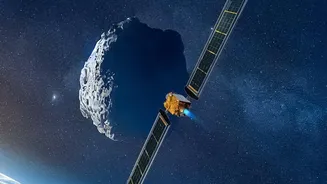
This work has profound implications for planetary defense. The kinetic impactor method, successfully demonstrated by NASA's DART mission in 2022, is one of our leading strategies. DART proved that we can alter an asteroid's orbit by crashing a spacecraft into it. However, for a last-resort scenario involving a large or fast-moving threat, a nuclear burst might be considered. This new simulation provides a critical insight: to effectively use such a method, we would need detailed, 3D maps of the asteroid's shape. Knowing its topography would allow mission planners to calculate the optimal point of impact to maximize the nudge and minimize unpredictable spins, turning a potential catastrophe into a manageable near-miss.