



The Solar System's Volcanic Giant
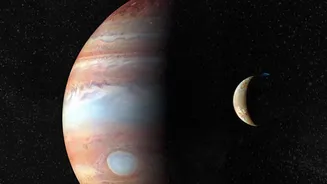
In the cosmic neighbourhood of Jupiter, among its many moons, Io stands out. It is not a quiet, icy world like its sibling Europa, but a raging volcanic powerhouse. With hundreds of active volcanoes, some spewing lava dozens of kilometres high, Io is the most
geologically dynamic body in the solar system. This intense activity is a result of a relentless gravitational tug-of-war. Jupiter’s immense gravity pulls on Io, while its neighbouring moons, Europa and Ganymede, pull from the other side. This constant stretching and squeezing generates enormous friction and heat within the moon's interior, fuelling its spectacular and violent eruptions. For decades, scientists have studied this fiery world, mapping its lava flows and colourful sulphur deposits, trying to understand the engine that drives it.
A Lightweight Mystery
Despite its violent nature, Io presented a persistent puzzle. For a rocky moon of its size, scientists expected it to have a certain density. However, measurements consistently showed it was lighter than it should be. Io is known to have a metallic core and a silicate mantle, much like Earth, which should give it a substantial mass. Yet, the numbers didn't quite add up, leading to various theories about its internal structure. Some models proposed a deep, global ocean of magma, while others suggested a different composition entirely. This discrepancy between its expected and observed density has been a nagging question for planetary scientists, suggesting a fundamental piece of Io’s story was missing.
The Porosity Hypothesis
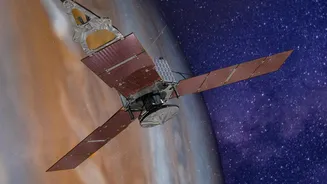
Recent data from NASA’s Juno spacecraft may have finally solved the riddle. During close flybys in late 2023 and early 2024, Juno used its Microwave Radiometer (MWR) to peer beneath Io's surface for the first time. The findings, published in the Journal of Geophysical Research: Planets, were surprising. The data indicates that Io’s uppermost crust is not solid, dense rock. Instead, it appears to be a lightweight, porous material, with a density similar to pumice or fluffy volcanic ash. Think of a sponge or a piece of pumice stone, both of which are full of holes and air pockets, making them far lighter than a solid block of the same material. The inferred density of Io's surface material is about 0.7 to 1.1 grams per cubic centimetre, consistent with porous volcanic material rather than solid rock.
From Fire Comes Fluff
This porous crust is a direct consequence of Io’s extreme volcanism. When lava erupts violently and cools rapidly, gases trapped within the molten rock don't have time to escape. This process creates a lightweight, hole-filled rock structure. Researchers believe Io is covered in these layers of volcanic ash, sulfur frost, and other erupted debris that constantly resurface the moon. This perpetually accumulating blanket of 'fluffy' rock buries older, potentially denser terrain. The Juno data suggests this low-density upper layer may sit above denser material several meters down. This layered structure would explain why the overall density of the moon, when measured from afar, appears lower than expected for a solid rocky body.
New Ways of Seeing a Moon
The MWR instrument on Juno was originally designed to look through Jupiter's thick clouds, not to probe a rocky moon. Its successful application at Io has opened up a new way to study planetary bodies. For the first time, scientists could measure the temperature beneath the surface, finding that it rises sharply just a few feet down, a clear sign of heat escaping from the interior. This breakthrough not only solves the density mystery but also provides a clearer picture of how heat moves through Io's crust. Scientists believe these microwave techniques could even be used to better monitor volcanoes here on Earth, potentially providing new information about how heat moves before an eruption. Io, a strange and distant moon, has once again given us a new lens through which to view our own planet and the dynamic processes that shape rocky worlds across the cosmos.