





A New Scar on Our Nearest Neighbour
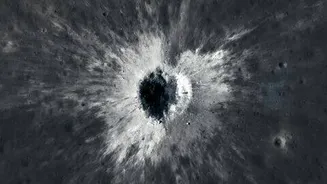
The Moon has a new, prominent feature. Named McGetchin crater, this fresh scar was gouged into the eastern edge of the lunar surface sometime between April and May of 2024. The impact was caused by an asteroid or comet fragment estimated to be the size
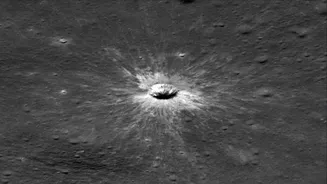
of a three- to six-storey building. The resulting crater is immense, measuring approximately 222 meters (728 feet) across and 43 meters (141 feet) deep. To put that into perspective, it spans the length of two football fields and is deep enough to swallow three school buses stacked vertically. Unlike Earth, the Moon has almost no atmosphere to burn up incoming projectiles, making it a more frequent target for cosmic debris.
The Cosmic Detective Story
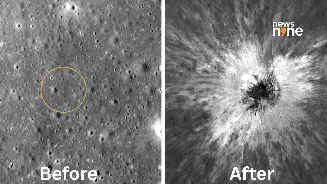
The discovery of McGetchin crater was a story of patience and sharp eyes. The event itself, the moment of impact in 2024, went completely undetected by telescopes on Earth or in space. NASA's Lunar Reconnaissance Orbiter (LRO), which has been mapping the Moon for over 17 years, captured images of the area shortly after the crater was formed. However, with the vast amounts of data the LRO collects, the feature wasn't immediately noticed. It wasn't until October 2025 that Robert Wagner, an image specialist, spotted an unusually bright patch surrounded by a dark halo during a routine data check. Realising this was a new feature, scientists used the LRO to take more detailed follow-up images, confirming the discovery and announcing the findings in September 2026.
What 'Largest Recent' Really Means
While the Moon is covered in craters far larger than McGetchin, this one is special because of its age. The headline claim that it is the 'largest recent impact crater' is significant because it's the largest crater for which we have 'before and after' images, allowing for an unprecedented study of a fresh impact. Scientists estimate that an impact of this magnitude happens on the Moon only about once every 132 years, making it a genuinely rare, 'once-in-a-lifetime' observation. Before this, the largest known contemporary crater found on the Moon was less than a third of McGetchin's size, highlighting the scale of this new discovery.
More Than Just a Hole in the Ground
The scientific value of McGetchin extends far beyond its impressive dimensions. Researchers discovered that the impact had a surprising effect on the surrounding landscape. Data revealed a seven-kilometer-wide 'cold spot' around the crater. During the lunar night, this area is about 9 degrees Celsius (16 degrees Fahrenheit) cooler than its surroundings. This is because the force of the impact 'fluffed up' the top layer of lunar soil, known as regolith, making it less dense and less able to retain heat. This discovery provides a natural laboratory for understanding how impacts alter the lunar surface, which has practical implications for designing future rovers and planning landing sites for astronauts.
A Tribute Etched in Moondust
In line with astronomical tradition, the significant new feature was given a formal name. The crater is officially named McGetchin in honour of Thomas R. McGetchin, a pioneering American planetary scientist and former director of the Lunar and Planetary Institute. McGetchin was influential during the Apollo era, contributing greatly to our foundational understanding of lunar geology. Naming this remarkable, once-in-a-century crater after him serves as a lasting tribute to his legacy, connecting the past and present of lunar exploration.