

A Nation on the Ring of Fire
Japan's geography is both beautiful and precarious. Situated along the Pacific Ring of Fire, one of the world's most active seismic zones, the country is no stranger to the immense power of earthquakes and tsunamis. This constant threat has fostered a culture
of preparedness and driven the nation to become a global leader in disaster mitigation technology. The devastating 2011 Tōhoku earthquake and tsunami served as a powerful catalyst, exposing the limitations of land-based detection and highlighting the urgent need to see disasters coming sooner. While on-land seismographs are effective, they can only raise the alarm after the primary shockwaves (P-waves) have already reached the coast. For offshore quakes, that leaves precious little time before the more destructive secondary waves (S-waves) and potential tsunamis arrive.
The Undersea Sentinel: S-net and DONET
In response, Japan invested heavily in moving its eyes and ears to the seafloor. The result is one of the most advanced offshore monitoring systems in the world, primarily composed of two key networks: S-net and DONET. S-net, the Seafloor Observation Network for Earthquakes and Tsunamis, is a massive web of fibre-optic cables stretching thousands of kilometres along the Japan Trench, the volatile region where the 2011 quake originated. This network connects 150 observatories on the ocean floor. It is complemented by DONET, the Dense Oceanfloor Network System for Earthquakes and Tsunamis, which monitors the Nankai Trough, another high-risk zone off southwestern Japan. Together, these systems, part of a larger integrated network called MOWLAS, form a comprehensive early-warning shield.
How the Seafloor Network Works
Each underwater observatory is a technological marvel, equipped with high-sensitivity seismometers, accelerometers, and water pressure gauges. When an earthquake occurs, the seismometers detect the initial ground motion. Simultaneously, the pressure gauges measure changes in the water column above them, allowing for the rapid detection of tsunami waves as they begin to form. Because these sensors are located directly over the source of many of Japan's most dangerous quakes, they detect the event much earlier than land-based stations. This data is transmitted in real-time via the subsea fibre-optic cables to the Japan Meteorological Agency (JMA). The agency's systems then instantly analyse the data to calculate the earthquake's epicentre, magnitude, and potential tsunami impact.
From Seabed Signal to Public Alert
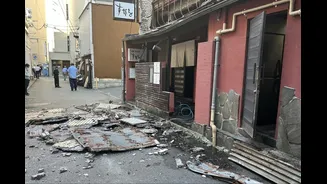
The speed of this process is what makes it so effective. Within moments of detection, the JMA issues an Earthquake Early Warning (EEW). This alert is broadcast across a multitude of platforms, from national television and radio to automatic alerts on mobile phones. The goal is to give people anywhere from a few seconds to over a minute of warning before the strongest shaking arrives. The system is designed to trigger when a significant quake is anticipated, providing a crucial window for people to take protective action, such as getting under a sturdy desk or moving away from dangerous objects. A recent 7.1 magnitude quake in Kumamoto on July 28, 2026, demonstrated the system's rapid response, with emergency alerts issued across seven prefectures.
The Power of Precious Seconds
While a few seconds might not sound like much, they can be the difference between life and death. The EEW system automatically triggers safety protocols across the country. Famously, Japan's Shinkansen bullet trains are connected to the system and can begin to brake automatically before a tremor hits, preventing catastrophic derailments. Elevators can be programmed to stop at the nearest floor and open their doors, industrial assembly lines can halt, and surgeons can pause delicate procedures. For the public, it provides just enough time to execute the well-practised 'drop, cover, and hold on' manoeuvre, significantly reducing injuries from falling debris. For tsunamis, the offshore system can provide up to 20 minutes of additional warning time, which is invaluable for coastal evacuations.