




The Challenge of Lunar Line-of-Sight
Communicating in space has always been a straightforward, if distant, affair: you need a direct line of sight. For missions on the near side of the Moon, this is simple. But the moment a rover dips into a crater or an orbiter flies over the far side,
it enters a communications blackout. This has been a fundamental limit since the Apollo era, effectively rendering half of the Moon and its most scientifically intriguing, resource-rich polar regions inaccessible for continuous, real-time operations. Future ambitions, like establishing a permanent lunar base under the Artemis program, require a more robust solution than scheduled, temporary contact. You can't build a sustainable presence if your connection keeps dropping.
Introducing LunaNet: Wi-Fi for the Moon
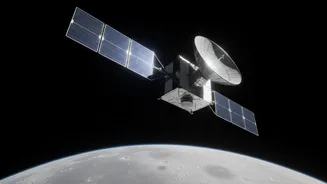
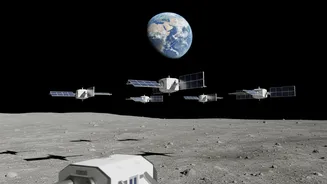
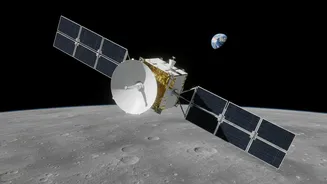
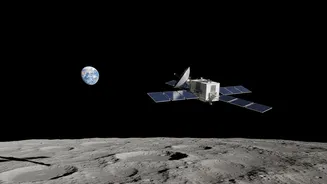
NASA's solution is a visionary architecture called LunaNet. Forget single point-to-point connections; think of this as an internet for the Moon. LunaNet is a framework for a network of satellites in lunar orbit that will act as relays. These satellites will pass signals from lunar assets—whether on the surface or in orbit—to each other and back to Earth, completely bypassing the line-of-sight problem. It is designed to be a flexible and extensible system, not just a set of NASA satellites. The idea is to create a network where commercial and international partners can add their own satellites, or 'nodes', creating an interoperable system for all lunar explorers. This approach mirrors the way the internet on Earth works, where various providers connect to a shared network.
More Than a Megaphone: GPS on the Moon
These relay satellites do more than just pass along messages. Their second, equally critical function is providing Positioning, Navigation, and Timing (PNT) services—essentially, a GPS for the Moon. By triangulating signals from multiple satellites in the LunaNet constellation, a rover on the surface or an astronaut on a spacewalk can determine their precise location, velocity, and the exact time. This is a game-changer for lunar exploration. It allows for autonomous navigation, enabling rovers to travel further and more safely without constant human intervention. It also ensures pinpoint precision for landing craft, a crucial factor when trying to set down near a pre-established base or a specific geological feature.
Unlocking New Lunar Frontiers
With constant communication and reliable navigation, the entire Moon opens up. Scientists can finally operate rovers and landers on the far side, a unique radio-quiet zone perfect for astronomy, and study its distinct geology. Artemis astronauts exploring the south pole for water ice will have a constant, reliable link to Mission Control, drastically improving safety and operational efficiency. This infrastructure moves lunar exploration from a series of daring, short-term sorties to a phase of sustained scientific and commercial activity. It's the foundational step needed to build and operate long-term lunar habitats, power grids, and resource extraction facilities.
A Commercial-First Approach
Instead of building and launching the entire satellite network itself, NASA is fostering a new commercial market for lunar communications. Through its Commercial Lunar Payload Services (CLPS) and other programs, NASA is contracting private companies, like Intuitive Machines and Firefly Aerospace, to build, launch, and operate these relay services. NASA acts as an anchor customer, guaranteeing a market for these services while allowing the companies to sell bandwidth to other clients, such as international space agencies or other private ventures. This strategy accelerates development, reduces costs for the US taxpayer, and seeds a vibrant commercial economy in cislunar space, the region between Earth and the Moon.