




The Case of the Missing Gas
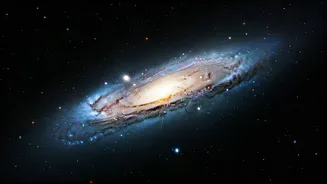
Imagine trying to build something magnificent, only to find a huge portion of your raw materials have vanished. Astronomers have faced a similar conundrum for years. According to our best models of the universe's evolution, massive galaxies should be surrounded
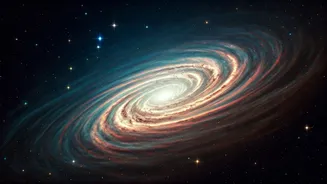
by vast, sprawling halos of gas—the stuff from which stars are born. This gas, composed of normal matter (known as baryonic matter), should be detectable. Yet, when scientists look at many of these giant galaxies, they find that a significant portion of this expected gas is simply not there. It’s a huge, galaxy-sized hole in our understanding of cosmic structure. Where did all this matter go? Was it never there to begin with, or was it forcibly removed by some unseen cosmic force? This "missing baryon problem" has been one of the biggest loose ends in astrophysics, prompting a search for a mechanism powerful enough to reshape an entire galaxy.
Meet the Galaxy's Engine
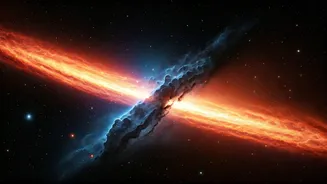
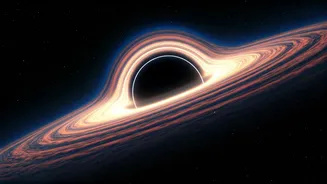
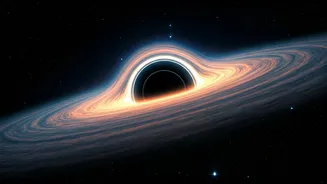
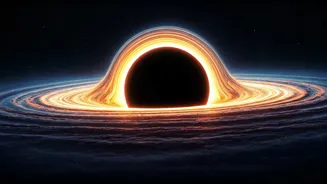
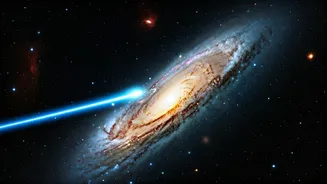
At the heart of nearly every large galaxy, including our own Milky Way, lurks a monster: a supermassive black hole. These objects are millions or even billions of times more massive than our sun. For much of their lives, they are relatively dormant. But when they actively feed on surrounding gas and stars, they flare into what is known as a quasar—one of the most luminous objects in the universe. This intense activity isn't a neat and tidy process. As matter spirals into the black hole, it heats up and releases an unbelievable amount of energy. This energy can drive powerful outflows, creating what astronomers call "black hole winds." These aren't winds in the earthly sense, but rather torrents of particles blasted outwards at speeds that can approach a significant fraction of the speed of light. For decades, scientists have theorized that these winds could have a profound impact on their host galaxies.
Powerful Winds Caught in the Act
Recent observations have provided some of the most direct evidence yet that these winds are the culprit behind the missing gas. In one study, astronomers analyzed years of data from a quasar known as SBS 1408+544. By examining how light from the quasar was absorbed by the gas being blown away, they could measure the wind's velocity. The results were stunning: the winds were not only moving at over 10,000 miles per second but were also accelerating. Other studies, using different methods, have confirmed that these outflows are powerful enough to push gas right out of the galaxy's gravitational grip and into the vast emptiness of intergalactic space. The data suggests these winds can eject enormous quantities of matter from a galaxy over its lifetime, easily accounting for the missing gas.
Why This Changes Everything
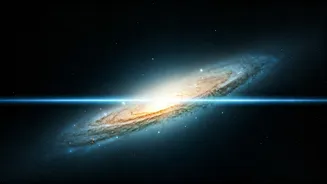
This discovery does more than just solve the mystery of the missing gas. It provides a crucial piece of the puzzle of how galaxies live and die. A key part of galactic evolution is star formation, and for stars to form, you need reservoirs of cold, dense gas. If a supermassive black hole's winds are constantly heating and ejecting this gas, it effectively shuts down the galaxy's star factory. This process, known as "feedback," explains why many of the most massive galaxies in the universe stopped forming new stars billions of years ago. They aren’t just old; their central engines actively sterilized them, preventing new generations of stars from being born. This means black holes aren't just cosmic vacuum cleaners; they are active regulators of galactic growth, shaping the appearance and fate of the very structures that populate our universe.