



Our Sun's Protective Bubble
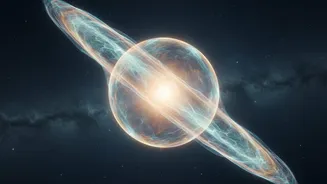
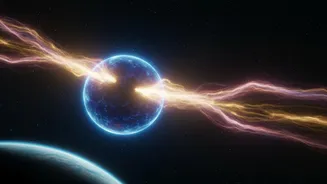
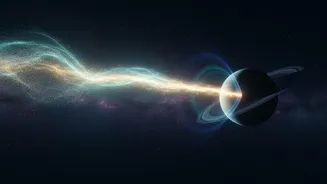
Our solar system isn't just floating naked in the vastness of space. It's enclosed within a massive, protective bubble known as the heliosphere. This bubble is inflated by the solar wind, a constant stream of charged particles flowing outward from the Sun
at supersonic speeds. It extends far beyond the planets, acting as a crucial shield that deflects a significant portion of the harsh galactic cosmic rays originating from distant star explosions and other violent cosmic events. Without this bubble, life on Earth would be exposed to much higher levels of dangerous radiation. The heliosphere is our solar system's first line of defense as it journeys through the interstellar medium—the mix of gas, dust, and magnetic fields that fills the space between stars.
IMAP: A New Kind of Cosmic Cartographer
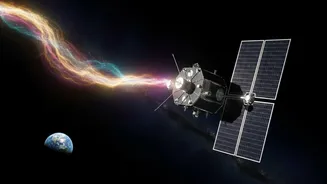
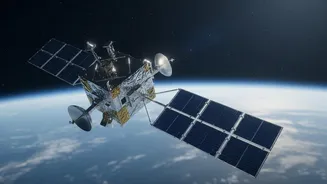
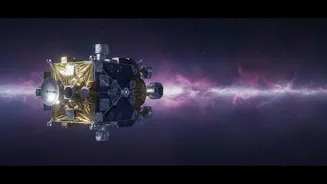
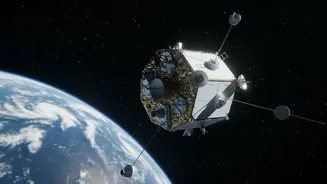
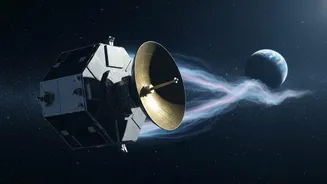
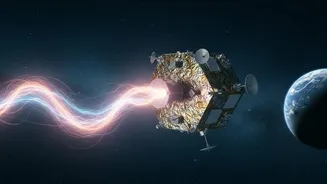
Charting the boundaries of this invisible bubble is the primary job of NASA's IMAP mission. Launched in September 2025, the spacecraft is a modern-day celestial cartographer designed to create the most detailed maps yet of the heliosphere's edge. From its strategic vantage point about one million miles from Earth towards the Sun, IMAP uses a suite of ten advanced science instruments to study the complex interaction between the solar wind and the interstellar medium. Previous missions like the Voyager probes and the Interstellar Boundary Explorer (IBEX) gave us the first tantalizing glimpses of this boundary. IMAP builds on their legacy with technology capable of seeing this region with far greater resolution and detail, helping to resolve lingering mysteries about its shape and structure.
How to Map an Invisible Boundary
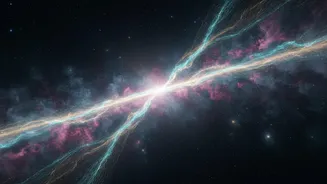
So how do you map something you can't see? IMAP’s key technique involves detecting special particles called energetic neutral atoms, or ENAs. These particles are created at the very edge of the heliosphere, in the region where the hot solar wind collides and mixes with the cold interstellar medium. During this cosmic collision, fast-moving charged particles from the solar wind can snatch an electron from slow-moving neutral atoms from interstellar space, becoming electrically neutral themselves. Unlike charged particles, these newly formed ENAs are no longer affected by magnetic fields, so they travel in straight lines across the solar system. By capturing these messengers and tracing their paths backward, IMAP's instruments can build a detailed, three-dimensional map of their distant origin point, effectively making the invisible visible.
What the First Data Reveals
The release of the first public data, announced on August 7, 2026, marks a major milestone for the mission. Following its successful launch and arrival at its operational orbit, IMAP's instruments underwent a commissioning phase and collected their 'first light' data in late 2025, confirming all systems were working perfectly. Now, data collected through April 2026 from seven of the ten instruments is available to the global scientific community. This initial dataset provides the building blocks for the first high-resolution maps of the heliosphere. It also contains rich information about the composition of the solar wind and the interstellar particles that manage to filter through our cosmic shield. This treasure trove of information allows scientists to begin testing their theories about the forces that shape our solar bubble in unprecedented detail.
Why This Cosmic Map Matters
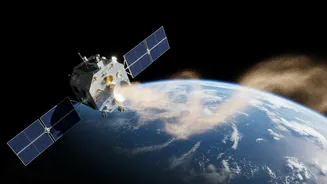
This research is about more than just satisfying scientific curiosity. A clearer understanding of the heliosphere has direct practical benefits. By monitoring the solar wind in real-time, IMAP also serves as a critical space weather sentinel. Its instruments can provide about a 30-minute advance warning of incoming bursts of solar radiation that could endanger astronauts, damage satellites, and disrupt power grids on Earth. This forecasting ability is especially crucial as humanity plans for long-duration missions to the Moon and Mars. Ultimately, by mapping our own protective bubble, IMAP is helping us understand what makes a solar system habitable and providing critical knowledge to protect our technology and explorers as we venture farther from home.