







A World of Continuing Surprises
Ever since NASA's New Horizons spacecraft zoomed past Pluto in 2015, it has been rewriting the book on this remote world. Before that historic encounter, Pluto was little more than a fuzzy dot, presumed by many to be a cold, inactive ball of ice and rock.
But the images sent back revealed a stunningly complex and dynamic landscape, complete with towering mountains of water ice, vast plains of frozen nitrogen, and a surprisingly layered atmosphere. The most iconic feature is Sputnik Planitia, the western lobe of a giant, heart-shaped glacier made of nitrogen ice that is larger than Texas and Oklahoma combined. This region, remarkably free of craters, hinted that the surface was geologically young and active. Now, a fresh analysis of that same data provides another startling twist in Pluto's story.
The Mystery of the Dark Streaks
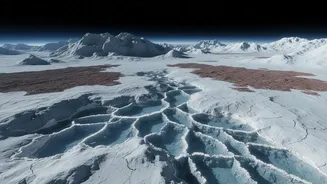
The latest discovery focuses on the northern edge of the Sputnik Planitia glacier. In the 2015 images, scientists noted a network of dark, linear streaks and more diffuse patches that traced the boundaries of large, city-sized polygonal blocks of ice. These features were puzzling. What could be causing these specific areas to darken on an otherwise bright, icy surface? Researchers have now proposed a compelling, if unexpected, explanation. After comparing the patterns on Pluto to imagery of glaciers here on Earth, they found a striking resemblance to areas on ice sheets that have been wetted by liquid water. This led them to a bold hypothesis: the dark features on Pluto are stains left behind by flowing liquid.
The Case for Liquid Nitrogen
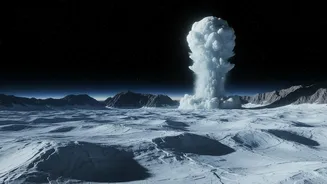
Liquid on a world where surface temperatures plummet to around minus 230 degrees Celsius seems impossible, and in one sense, it is. Pluto's thin atmosphere and extreme cold mean that liquid nitrogen rain is physically impossible. So, if liquid is present, it must be coming from somewhere else: from below. According to a new study published in the Planetary Science Journal, the source is likely a process called basal melting. Computer models suggest that heat radiating from Pluto’s rocky core could be just enough to melt the nitrogen ice at the very bottom of the kilometers-deep Sputnik glacier. This liquid nitrogen, being less dense than the solid ice above it, would then be forced upward through cracks and fissures in the ice sheet, a process compared to how magma moves through volcanic dikes on Earth.
A Geologically Active Pluto
Once this subsurface liquid nitrogen erupts onto the surface, it would briefly flow before refreezing, 'wetting' the surface and causing it to darken. This is the first strong evidence for recently flowing liquid on the dwarf planet. The term 'recent' in geology can mean anything within the last million years, but it nonetheless points to a world that is far from static. “Pluto never stops surprising us,” said Alan Stern, the principal investigator of the New Horizons mission. This finding not only suggests a form of active 'plumbing' beneath the ice but also implies that Pluto may have time-variable features, meaning its surface could be changing even now. This discovery fundamentally changes our perception of Pluto from a simple frozen orb to a complex, geologically active body with ongoing processes shaping its landscape.