

A Cosmic Dance Card
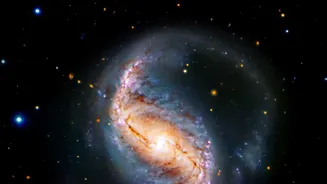
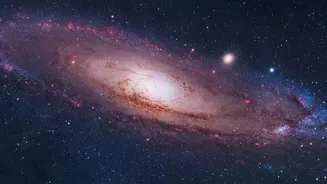
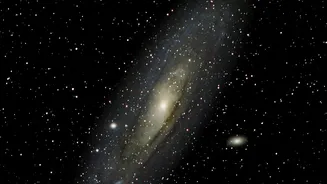
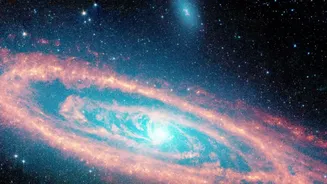
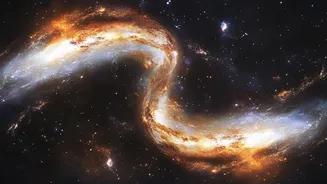
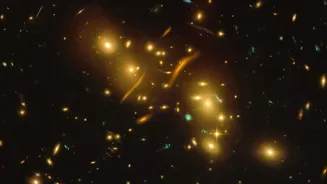
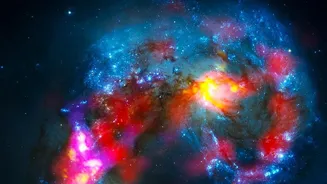
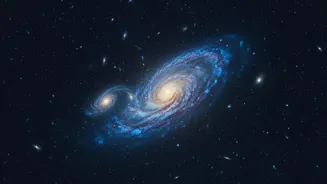
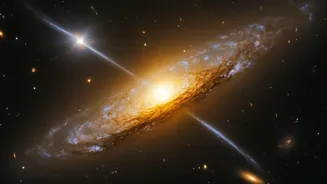
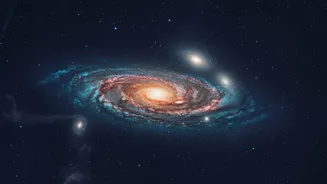
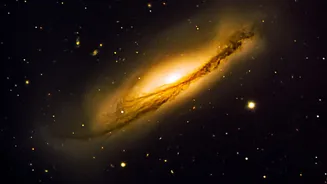
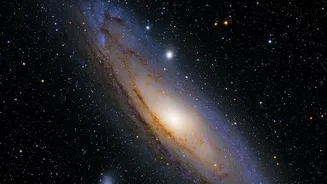
The image, a composite from data likely gathered by space telescopes like Hubble or Webb, presents a visual timeline of cosmic evolution. One pair of galaxies appears to be in the early stages of a gravitational tango, their spiral arms just beginning
to stretch and distort. Another pair is captured mid-collision, a chaotic and beautiful mashup where tidal forces are pulling long streams of stars and gas from each participant. The final duo is in the late stages of a merger, their individual structures now almost entirely blended into a new, larger, and more chaotic entity. Seeing these different phases side-by-side provides a unique laboratory for astronomers. It’s like having a photo album of a galaxy’s entire life, from courtship to union, all in one glance.
When Galaxies Collide
Contrary to how it might sound, a galactic 'collision' isn't like a car crash. The distances between individual stars are so vast that it's incredibly rare for stars to actually hit each other. Instead, the battle is one of gravity. As two galaxies draw closer, their immense gravitational fields begin to warp and disrupt one another. This process, which can take hundreds of millions of years, is known as violent relaxation. The powerful gravitational pull compresses vast clouds of interstellar gas and dust, triggering furious bursts of star formation. These stellar nurseries light up the merging galaxies, creating some of the most luminous objects in the universe, known as ultra-luminous infrared galaxies (ULIRGs). The long, graceful trails of stars and gas pulled from the galaxies, called tidal tails, are a telltale signature of these powerful encounters.
A Uniquely Comprehensive View
The significance of this new image lies in its comparative power. Astronomers have studied many interacting galaxies over the years, from pairs like the Antennae and Mice galaxies to triplets and even larger groups. However, capturing three distinct pairs at varying stages of interaction in one field of view is exceptionally valuable. It allows for a more direct comparison, stripping away variables that can complicate studies of single systems. By observing how the process unfolds across these different examples, scientists can refine their models of galaxy evolution. They can better understand how these mergers build larger galaxies, fuel the growth of the supermassive black holes at their centers, and ultimately shape the large-scale structure of the cosmos. These interactions are a fundamental part of how the universe builds itself up over billions of years.
The Milky Way’s Distant Future
This glimpse into deep space is also a preview of our own galaxy's destiny. The Milky Way is currently on a collision course with our nearest large galactic neighbor, the Andromeda galaxy. In about 4.5 billion years, our two spiral galaxies will begin a merger process strikingly similar to those seen in NASA's new image. While our solar system will likely survive—the vast distances between stars make a direct hit improbable—it could be flung into a completely different region of the newly formed, larger galaxy, which some astronomers have nicknamed 'Milkomeda'. The night sky for any potential future inhabitants of Earth would become a spectacular, ever-changing canvas as Andromeda grows to fill the view before the two galaxies merge into a giant elliptical galaxy. Viewing these distant collisions isn't just an academic exercise; it’s a window into the future of our own cosmic home.