






Your Hips on Desk Duty
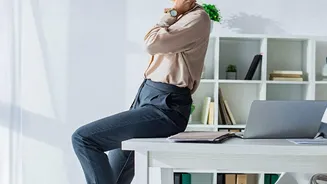
The human body is designed for movement, but the modern desk job forces it into a static, seated position for hours. This has a significant impact on the complex structure of your hips. When you sit, your hip flexor muscles, which run along the front
of your hips, are held in a constantly shortened position. Over time, these muscles can become chronically tight and stiff. Simultaneously, your gluteal muscles—your body's powerhouse for stability and movement—become inactive and weak from lack of use. Experts call this phenomenon “gluteal amnesia,” where your glutes essentially forget how to fire properly. This combination of tight flexors and weak glutes creates a major imbalance around the pelvis, laying the groundwork for pain and dysfunction.
The Ripple Effect of Stiff Hips
The consequences of poor hip mobility extend far beyond localized stiffness. Because the hips are central to almost every move you make, when they don't function properly, other parts of your body are forced to compensate. One of the most common side effects is lower back pain. Tight hip flexors can pull the pelvis forward, putting a strain on the lumbar spine. Weak glutes mean your lower back and hamstrings have to work overtime to stabilize your body, leading to fatigue and soreness. This chain reaction can also travel down to your knees, which may experience pain due to altered movement mechanics during simple activities like walking or climbing stairs. In essence, what starts as a hip problem rarely stays a hip problem; it becomes a whole-body issue.
Simple, Desk-Friendly Yoga Stretches
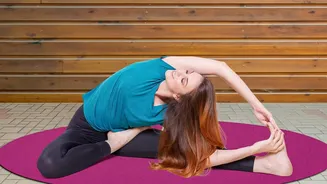
The good news is that you can counteract these effects with simple, consistent movement. You don't need a full yoga class to find relief. These discreet, yoga-inspired stretches can be done right at your workstation. 1. Seated Figure-Four Stretch: While sitting upright in your chair, cross your right ankle over your left knee, creating a "figure four" shape. Gently press down on your right knee to feel a stretch in your outer hip and glute. For a deeper stretch, hinge forward at your hips with a straight back. Hold for 20-30 seconds and repeat on the other side. 2. Chair Pigeon Pose: Scoot to the edge of your chair. Extend your left leg straight behind you, resting the top of your foot on the floor. Keep your right knee bent at a 90-degree angle in front. You should feel a stretch in the front of your left hip. Hold for 20-30 seconds, then switch sides. 3. Standing Quad Stretch: Stand up and hold onto your desk for balance. Bend your left knee and grab your left ankle, gently pulling your heel toward your glute. Keep your knees aligned and stand up tall to feel a stretch in your quad and hip flexor. Hold for 20-30 seconds before switching legs.
Make Mobility a Habit, Not a Chore
The key to improving hip mobility isn't performing one intense stretching session a week; it's about integrating small, frequent movements throughout your day. Consistency triumphs over intensity. Try setting a timer to remind yourself to get up and move every 30 to 60 minutes. Even a short walk to the water cooler or a quick stretch can break the cycle of static sitting. Think of these movements not as an interruption to your work, but as a crucial part of maintaining the tool that allows you to do your work: your body. By making these micro-breaks a non-negotiable part of your routine, you actively invest in your long-term health and prevent the gradual decline in mobility that a sedentary job can cause.