









An Ambitious Plan
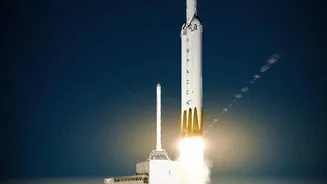
The 14th test flight of Starship on September 28, 2026, was its most ambitious yet. The plan was for the uncrewed spacecraft, the largest and most powerful rocket ever built, to circle the globe six times over nearly 10 hours. After launching from Starbase
in Texas, it was intended to reach an altitude of about 275 kilometers (171 miles) before eventually splashing down in the Pacific Ocean near Chile. This long-duration flight was designed to be a crucial test of the vehicle's endurance and systems, a necessary step toward its goal of carrying NASA astronauts to the Moon and, eventually, settlers to Mars. For the first time, the mission also carried an operational payload: 26 of the latest-generation Starlink V3 internet satellites.
A Mid-Flight Anomaly
The mission faced a dramatic moment shortly after the Starship upper stage separated from its Super Heavy booster. One of the ship's six Raptor engines shut down prematurely during the ascent. Following tense discussions, mission control made the call to proceed with the orbital insertion burn, a maneuver that successfully pushed Starship into a stable orbit for the first time in the program's history. Despite this success, SpaceX announced about an hour and a half into the flight that the mission would be shortened. The company stated the decision was made "out of an abundance of caution given the engine issue experienced during ascent."
A Successful, Shortened Mission
Even with the revised plan, the flight achieved several major objectives. Reaching a stable orbit at an altitude of around 275 km was a landmark success after 13 previous suborbital test flights. The primary payload of 26 Starlink satellites was successfully deployed, adding significant new capacity to the company's global internet network. After about three hours, instead of the originally planned ten, Starship performed a deorbit burn and made a controlled reentry, splashing down in the Pacific Ocean north of Hawaii. While the mission was cut short, the ability to reach orbit, deliver a payload, and safely return despite an engine failure is seen by many as a sign of the vehicle's resilient design.
What This Means for SpaceX
This flight was a story of qualified success, demonstrating both Starship's incredible potential and the challenges that remain. Reaching orbit is a critical step for all of SpaceX's future plans, from launching larger Starlink satellite batches to fulfilling its contract with NASA to use Starship as a lunar lander for the Artemis program. However, the recurring engine issues are a concern that engineers will need to resolve to prove the vehicle's reliability for human spaceflight. The ability to assess the situation and opt for a safer, shorter mission profile highlights a mature operational approach. For SpaceX, the flight provided invaluable data, not only on what worked but also on how the spacecraft handles anomalies, which is crucial for a vehicle designed to be fully and rapidly reusable.