




A Surprising Discovery in Changthang
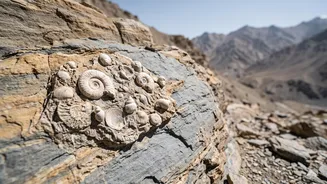
In the cold, arid landscape of Nyoma in Ladakh's Changthang region, a team of geologists has uncovered a treasure trove of marine fossils. The discovery was made by geologist Dr. Ritesh Arya, founder of the Tethys Fossil Museum, during a recent expedition.
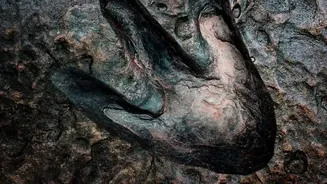
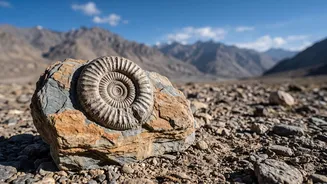
The collection is rich with snail-like gastropods, bivalves, and oyster-like forms that are astonishingly well-preserved. Preliminary analysis suggests these organisms lived and died between 34 and 38 million years ago, during the Eocene epoch. For Dr. Arya, the moment of discovery was a shock. He immediately recognised the fossils as being remarkably similar to those typically found in the Subathu Formation in the outer Himalayas, but finding them so far east in Nyoma was a complete surprise.
The Ancient Ocean That Vanished
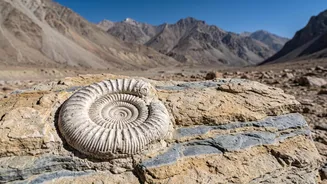
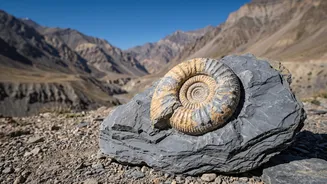
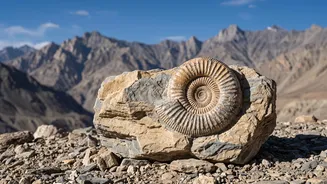
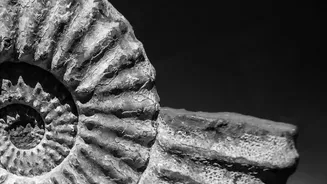
To understand how sea creatures ended up thousands of metres above sea level, we have to go back in time to an ancient world. Millions of years ago, the landmass we know as the Indian subcontinent was not attached to Asia. Separating the two was a vast body of water called the Tethys Ocean. This ocean was a cradle for diverse marine life, from microscopic organisms to large shelled creatures like ammonites. The floor of the Tethys Ocean was slowly covered by layers of sediment, which trapped and preserved the remains of the creatures that lived there, effectively creating a geological time capsule. These layers of sedimentary rock are what scientists now find in the high Himalayas, holding the secrets of this long-lost sea.
A Collision of Continents
The existence of the Tethys Ocean came to a dramatic end due to one of the most powerful geological events in Earth's history. The Indian tectonic plate, having broken away from the supercontinent of Gondwana, drifted northwards for millions of years. Around 50 million years ago, it began to collide with the Eurasian plate. This monumental collision caused the floor of the Tethys Sea to buckle, fold, and thrust upwards. The immense pressure squeezed the ancient seabed and lifted it skyward, forming the mighty Himalayan mountain range. What was once the bottom of a warm, shallow sea became the 'rooftop of the world'. The marine fossils found in Ladakh are physical proof of this incredible transformation, remnants of an ocean lifted into the sky.
What These Fossils Reveal
The Nyoma fossils are more than just a curiosity; they are a critical piece of a massive geological puzzle. Their age places them right in the period when the Tethys Sea was in its final stages, just before the full force of the continental collision. Scientists believe this discovery suggests that the ancient marine environment extended much farther east into Ladakh than previously thought. The presence of not just shells, but also fossilised palm trees and wood in the wider region, paints a picture of a landscape completely alien to the Ladakh of today—a warm, coastal area with subtropical vegetation. Detailed study of these fossils will help scientists precisely date the rock layers and better understand the environment and climate of this ancient coastline before it was pushed up to form the Himalayas.