





A Historic Liftoff from Baikonur
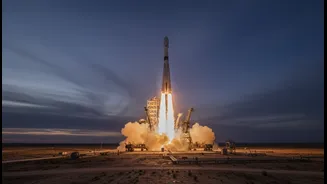
Blasting off from the historic Baikonur Cosmodrome in Kazakhstan, the Roscosmos Soyuz MS-29 spacecraft lit up the sky, carrying its three-person crew towards low-Earth orbit. Onboard is NASA astronaut Anil Menon, accompanied by veteran Roscosmos cosmonauts
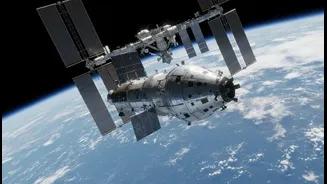
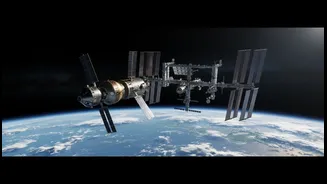
Pyotr Dubrov and Anna Kikina. The launch marks the start of an approximately eight-month mission aboard the orbiting laboratory. After a journey of just over three hours, the spacecraft is scheduled for an automated docking with the station's Prichal module, where they will join the existing crew of international astronauts and cosmonauts.
Who is Anil Menon?
Anil Menon is not just an astronaut; he's a physician, an engineer, and a decorated US Space Force colonel. Born in Minneapolis, Minnesota, to Indian and Ukrainian immigrant parents, his roots trace back to Kerala. His journey to the stars is built on a formidable foundation of service and science. He previously served as SpaceX's first flight surgeon, helping launch the company's first humans to space, and worked at NASA supporting astronauts on the ISS. His extensive experience also includes serving as a first responder in earthquakes in Haiti and Nepal and as a flight surgeon in the U.S. Air Force. Selected by NASA in 2021, this mission is his maiden spaceflight.
An Ambitious Mission in Orbit
Life aboard the ISS will be anything but idle for Menon and his crewmates. Their mission is packed with scientific research and technology demonstrations aimed at advancing long-duration human spaceflight. A major focus for Menon will be studying the physiological effects of microgravity on the human body, including research on blood flow and composition. He will also be involved in testing critical technologies for future deep-space missions, such as a system to produce IV fluids from the station's water supply and using AI-assisted ultrasound for medical examinations. Another key experiment involves manufacturing semiconductor crystals in microgravity, which could lead to breakthroughs in computing and medical devices back on Earth.
The Enduring Indo-Russian Partnership
This joint mission underscores the decades-long space partnership between India and Russia. This collaboration dates back to 1975 with the launch of India's first satellite, Aryabhata, on a Soviet rocket. It was a Russian spacecraft that took the first Indian citizen, Rakesh Sharma, to space in 1984. More recently, Russia has been a key partner in training the astronauts for India's own ambitious human spaceflight program, Gaganyaan. The presence of Menon on a Soyuz flight, a symbol of this enduring relationship, also carries a special payload: drawings by Indian schoolchildren celebrating the Russo-Indian space cooperation.
A Stepping Stone for Gaganyaan
While Menon is a NASA astronaut, his journey resonates deeply with India's own space aspirations, chief among them the Gaganyaan mission. The Gaganyaan program aims to make India the fourth nation to independently send humans into orbit. The four astronaut-designates for this program—all Indian Air Force pilots—have undergone extensive training in Russia, leveraging the same expertise that powers missions like Menon's. A mission like this provides invaluable data and experience, indirectly benefiting ISRO's efforts. It serves as a powerful inspiration and a practical demonstration of the complexities of human spaceflight as India prepares to launch its own crewed missions, now targeted for 2027.