




Our Turbulent Star
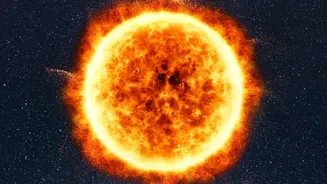
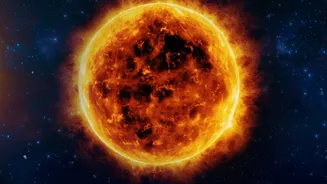
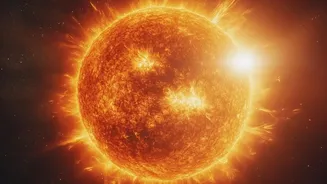
To understand this discovery, we first need to talk about sunspots. These dark patches on the Sun's surface are not blemishes but are actually cooler regions caused by incredibly intense magnetic fields. They are the epicentre of the Sun's most violent
outbursts, like solar flares. For centuries, astronomers have studied these spots to understand the Sun's 11-year activity cycle. They appear darker only because they are thousands of degrees cooler than their surroundings, a result of the magnetic fields suppressing the normal flow of hot gas from the Sun's interior. These magnetic behemoths are a visible sign of the powerful and complex engine churning deep within our star.
A Glimpse of Gold
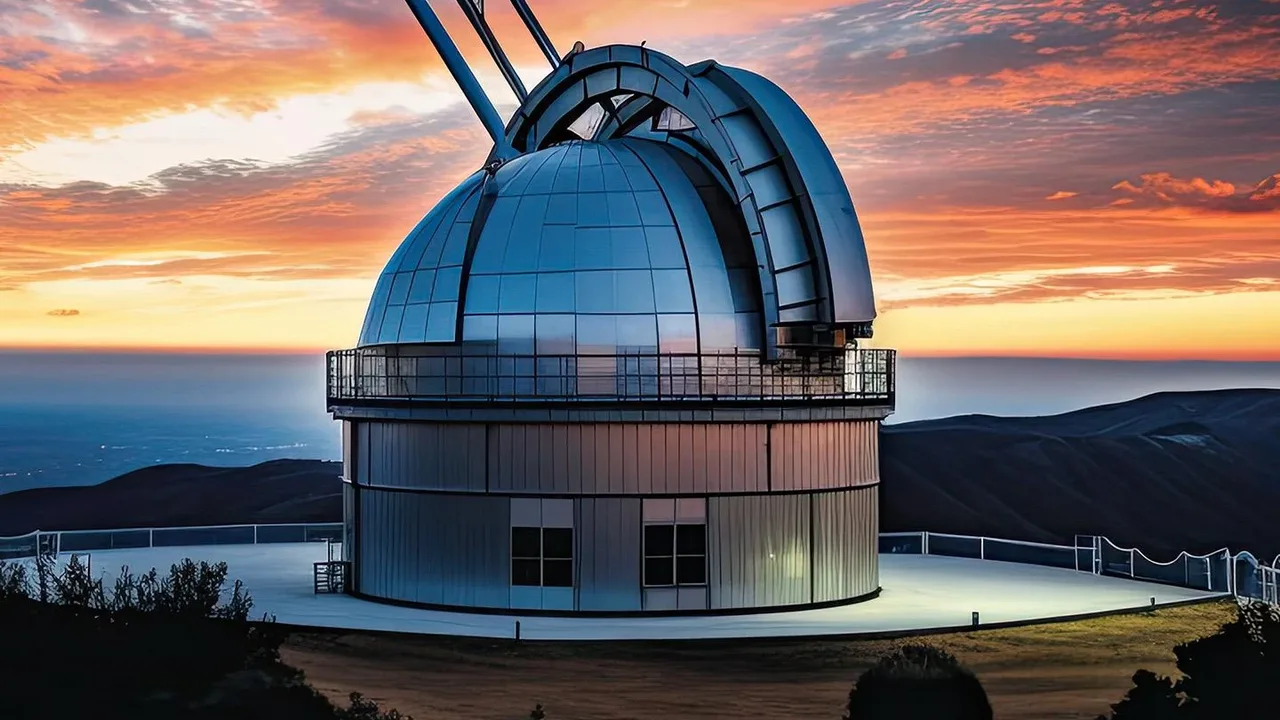
The latest breakthrough comes from the Daniel K. Inouye Solar Telescope in Hawaii, the most powerful solar telescope in the world. Its high-resolution images have captured something extraordinary: glowing, golden rings in the Sun's lower atmosphere, known as the chromosphere, positioned directly above a sunspot. These aren't literal bands of gold, but rather plasma—super-heated gas—that is glowing at specific temperatures. This unique glow allows scientists to visualise structures that were previously invisible, tracing the intricate dance of energy and magnetism just above the Sun's surface.
The Hidden Magnetic Dance
So, what is this hidden motion the golden bands reveal? The glowing plasma is tracing the path of powerful magnetic waves, known as Alfvén waves, rippling outwards from the sunspot below. These waves were first theorised in 1942 by Hannes Alfvén but observing them directly in this context has been incredibly difficult. They act like cosmic guitar strings, carrying enormous amounts of energy from the Sun's interior up into its atmosphere. The new observations show these waves propagating through the chromosphere, finally giving scientists a visual confirmation of a process that was long suspected to be a key driver of solar activity.
Solving a Solar Mystery
This discovery could be a major piece of the puzzle in solving one of solar physics' most persistent mysteries: the coronal heating problem. The Sun's outer atmosphere, the corona, is bewilderingly hotter than its surface—millions of degrees Celsius compared to just a few thousand. This defies simple logic; you would expect it to get cooler as you move away from a heat source. Scientists have long theorised that waves like the newly observed Alfvén waves could be responsible, transporting magnetic energy upwards where it dissipates as heat. Seeing these energy-carrying waves in action provides strong evidence for this theory and opens up a new avenue for understanding how the Sun's atmosphere gets super-heated.
Why It Matters on Earth
While this might seem like a distant, academic puzzle, understanding the Sun's magnetic engine has very real-world consequences. The same magnetic forces that create sunspots and heat the corona also power solar flares and coronal mass ejections—massive eruptions that hurl charged particles into space. This phenomenon is known as space weather. When directed at Earth, these solar storms can disrupt our satellites, cripple communication networks, damage power grids, and pose a risk to astronauts. By getting a clearer picture of the fundamental processes near the Sun's surface, like the motion revealed by these golden bands, scientists can improve their models and better predict space weather, giving us more time to prepare for and mitigate its effects.