


An Enduring Celestial Puzzle
For decades, scientists have puzzled over Venus's solitude in the night sky. The early solar system was a chaotic shooting gallery of colliding protoplanets, and the leading theory for our own Moon's formation involves a massive impact on a young Earth.
Given that Venus is so similar in size and mass, it seems probable that it, too, would have experienced a similar impact that could have birthed a satellite. Previous theories suggested that perhaps a later, catastrophic collision destroyed any moon that formed, or that Venus was simply unlucky and never had a moon-forming impact at all. But new research led by astrophysicist Stephen Kane at the University of California, Riverside, proposes a more elegant and chilling alternative: Venus may have been perfectly capable of forming a moon, but utterly incapable of keeping it.
The Crucial Role of Spin
The key to the mystery, according to new computer simulations, is the planet's rotation. Earth spins relatively quickly, completing a rotation in 24 hours. This rapid spin transfers rotational energy to our Moon, causing it to slowly drift farther away at a rate of about four centimetres per year. Venus is the polar opposite. A single day on Venus lasts 243 Earth days, meaning it rotates incredibly slowly. Kane’s models, published in The Astrophysical Journal, show that this sluggish rotation would have the reverse effect on a hypothetical moon. Instead of pushing it away, the planet's gravity would dominate the tidal interaction, causing the moon to gradually spiral inward toward its doom.
A Doomed Satellite
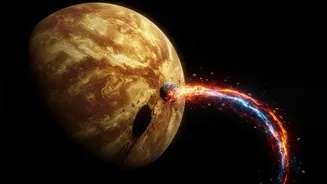
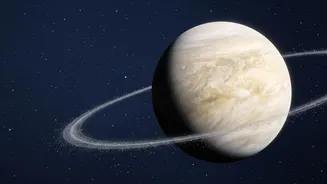
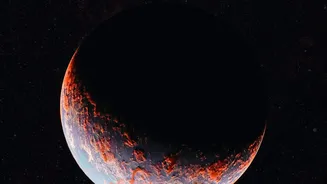
The research team ran numerous simulations, testing hypothetical Venusian moons of various sizes. In nearly every scenario, the outcome was the same: the moon was pulled back toward the planet. The simulations showed that as the moon orbited, its own gravity would have tugged on Venus, slowing its already leisurely rotation even further. This process would accelerate the moon's inward spiral. Eventually, it would cross the 'Roche limit'—a point where the planet's tidal forces are stronger than the moon's own gravity, tearing the satellite apart. The debris would likely form a temporary ring before raining down and being consumed by the planet in a cataclysmic event. According to the models, this process could have been startlingly fast, with a moon's destruction occurring in as little as 30 million years depending on its mass and the planet's initial spin.
The Overlooked Detail
The previously overlooked detail brought forward by this research is that a planet's own gravity and spin rate could be the natural mechanism for a moon's destruction, without needing a secondary catastrophe. “My study shows Venus didn't require a catastrophe to arrive at what we can see today,” Kane stated. “It turns out the gravity of the planet itself combined with the rate at which it spins naturally caused the moon to collapse on top of it.” The simulations suggest that the more massive a moon was, the faster its demise would have been, as its stronger gravitational pull would have slowed Venus's rotation more quickly, hastening its own inward death spiral. This provides a tidy explanation for why we see no moon today, even if one likely formed billions of years ago.
Implications for a Hellish World
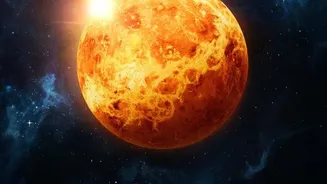
While the study does not definitively prove Venus ever had a moon, it presents a compelling case that if one existed, it could not have survived. Finding physical evidence of such a collision is difficult, as a major resurfacing event about a billion years ago is thought to have erased much of Venus's ancient geological history. However, the impact from a moon-sized object could have had profound consequences, delivering an enormous amount of energy that might have altered the planet's climate and contributed to the runaway greenhouse effect that makes Venus the hottest planet in the solar system. This new theory not only helps explain the state of our planetary neighbour but also has implications for exoplanets, suggesting that slowly rotating worlds may not be able to hold onto large moons, a factor that could influence their long-term habitability.