
An Atmosphere on the Move
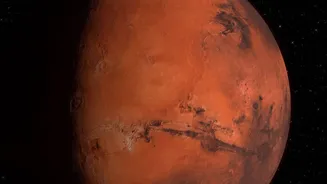
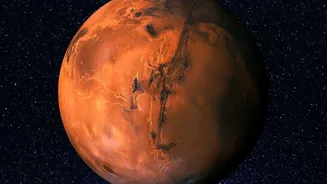
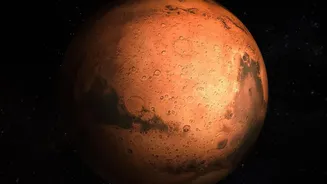
While humans couldn't breathe the thin, carbon dioxide-heavy Martian air, the atmosphere itself is incredibly dynamic. The 'breathing' refers to a massive, planet-wide exchange of carbon dioxide (CO2) between the atmosphere and the polar ice caps that
occurs with the changing seasons. Each Martian year, which is almost twice as long as an Earth year, about a quarter of the entire atmosphere is taken out of circulation and then released back again. This process is so significant it causes the global atmospheric pressure to rise and fall dramatically. This isn't a gentle process; it's a fundamental engine driving the Martian climate, creating powerful winds and shaping the planet's weather patterns.
The Winter 'Inhale'
As one of Mars's poles tilts away from the Sun and enters its long, dark winter, temperatures plummet to extremes we never see on Earth, getting cold enough for CO2 gas to freeze solid. This triggers the planetary 'inhale.' Carbon dioxide from the atmosphere precipitates directly onto the surface as frost and snow, forming vast, seasonal polar caps of dry ice. As this gas is pulled from the air and locked down as ice, the total mass of the atmosphere decreases, causing a planet-wide drop in air pressure. Scientists have measured this effect, confirming that the atmosphere literally thins out as Mars freezes a portion of its air onto one of its poles.
The Spring 'Exhale'
When spring arrives at the pole, the process reverses in a dramatic 'exhale'. Sunlight returns, warming the vast sheets of frozen CO2. On Mars, the pressure is too low for the dry ice to melt into a liquid. Instead, it sublimates—turning directly from a solid back into a gas. This pumps enormous quantities of carbon dioxide back into the atmosphere, causing the seasonal ice cap to shrink and global atmospheric pressure to rise again. This release of gas can be explosive. Sunlight penetrates translucent layers of ice, warming the dark ground underneath, which causes gas to build up until it erupts in geyser-like jets that spew dark sand and dust across the ice.
A Tale of Two Poles
The breathing cycle is not perfectly symmetrical. Mars has a more elliptical orbit than Earth, which means its seasons are not of equal length. The southern winter is longer and colder than the northern winter. As a result, the southern polar cap's seasonal freezing and thawing process is more extreme, involving a larger volume of carbon dioxide than its northern counterpart. Beneath these seasonal dry ice caps lie permanent caps made mostly of water ice, which hold a long-term record of the planet's climate history, much like the ice sheets in Greenland or Antarctica on Earth.
Why This 'Breath' Matters
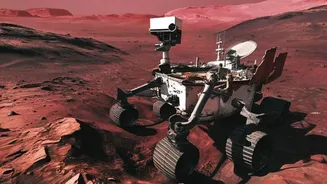
Studying this planetary respiration is crucial for understanding Mars. It governs the planet's atmospheric circulation and helps scientists model its past and future climate. For future human exploration, understanding these pressure cycles and the powerful winds they generate is essential for mission safety and planning. Furthermore, instruments like the MOXIE experiment on NASA's Perseverance rover have successfully demonstrated that it's possible to extract oxygen from the CO2 atmosphere. This shows that the very air that participates in this giant 'breathing' cycle could one day be used to provide breathable air and rocket propellant for astronauts, turning a hostile environment into a source of critical resources.