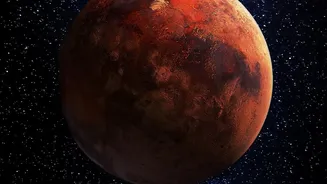





Of all the planets in our solar system, Mars holds a special place in our imagination. It's our planetary neighbour, and in a strange cosmic coincidence, its daily rhythm is strikingly similar to our own. But what does this really mean?
The 39-Minute Difference
At its heart, the
length of a day is determined by how long it takes a planet to complete one full rotation on its axis. For Earth, this solar day averages out to 24 hours. For Mars, it’s just a little bit longer. A Martian solar day, known to scientists as a 'sol', lasts approximately 24 hours, 39 minutes, and 35 seconds. This means that if you were standing on Mars, the time from one sunrise to the next would feel almost uncannily familiar. This small but persistent difference of about 2.5% has led mission planners at agencies like NASA to adopt Mars time for rover operations, with teams on Earth shifting their schedules by about 40 minutes each day to stay in sync with their robotic explorers millions of miles away.
A Tale of Two Rotations
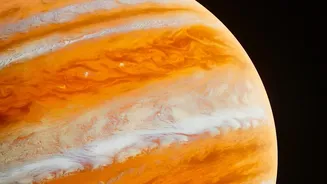
Why are the day lengths so similar? The answer is largely a matter of chance, rooted in the chaotic process of planetary formation. Billions of years ago, as dust and gas coalesced to form the planets, the countless collisions and gravitational nudges determined each planet's final spin. Earth and Mars just happened to settle into very similar rotational periods. This similarity is even more remarkable when you look at our other neighbours. Venus, for instance, has a day that is longer than its year, taking 243 Earth days to complete a single rotation. At the other extreme, the gas giant Jupiter spins incredibly fast, with a day lasting less than 10 Earth hours. The similar axial tilts of Earth (23.5 degrees) and Mars (25.2 degrees) also mean that Mars experiences seasons much like we do, though they last nearly twice as long.
Where the Similarities End
While the daily cycle is familiar, the Martian year is a different story entirely. Because Mars is farther from the Sun, its orbit is much larger. A Martian year—the time it takes to complete one trip around the Sun—is 687 Earth days, or about 668.6 sols. This means that someone living on Mars would celebrate their birthday only about half as often as they would on Earth. This much longer year, combined with a more elliptical orbit, creates seasons that are not only longer but also more extreme in their variation compared to Earth's. For example, spring in the northern hemisphere of Mars is the longest season, lasting for about seven Earth months.
The Challenge of Mars Lag
For future human explorers, this slight time difference could pose a unique challenge often dubbed 'Mars lag'. Living on a 24-hour and 39-minute cycle would mean constantly fighting against the human body's ingrained 24-hour circadian rhythm. Studies have shown that humans can adapt to slightly different day-night cycles, but the constant desynchronization could lead to sleep disturbances and affect performance. Mission planners are already studying how to manage this, with potential solutions including carefully controlled light exposure and scheduled meal times to help astronauts' internal clocks adjust to the Martian sol. It’s one of the many human factors that must be solved before we can establish a long-term presence on the Red Planet.
An Alien World, A Familiar Rhythm
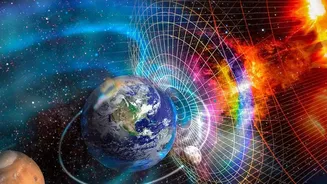
Beyond the time difference, future inhabitants would face an environment far more hostile than any on Earth. Mars has a thin atmosphere, offers little protection from solar and cosmic radiation, and experiences extreme temperature swings. Its surface is barren, and there is no global magnetic field to shield life from harmful energetic particles. Communications with Earth are also complicated, with delays ranging from four to 24 minutes each way, making real-time conversation impossible. During periods of solar conjunction, when the Sun is between the two planets, communication can be blacked out for weeks. These stark realities underscore that despite its familiar day, Mars remains a profoundly alien world.