
The Planet's Giant Conveyor Belt
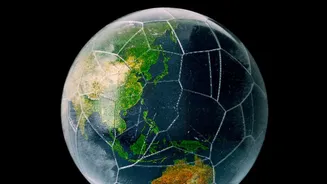
The secret to the Pacific's slow demise lies in plate tectonics. The Earth's surface isn't one solid piece; it's broken into massive plates that are constantly in motion, floating on the planet's molten mantle. These plates can move apart, creating new
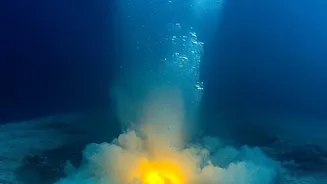
crust, or they can collide. When an oceanic plate collides with a continental plate, the denser oceanic crust is forced to bend and slide underneath. This process is called subduction. Think of it as a planetary recycling system: old ocean floor is consumed back into the Earth's interior along these massive trenches. While new seafloor is being created elsewhere, the Pacific is home to a vast network of these subduction zones that are consuming its crust faster than it can be replaced.
Welcome to the Ring of Fire
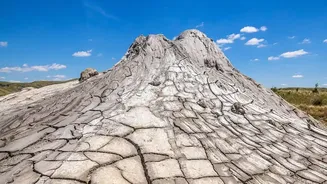
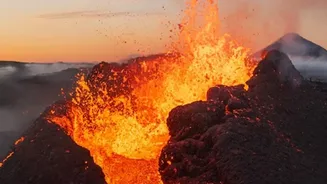
This network of destructive power has a famous name: the Ring of Fire. It's a nearly 40,000-kilometre, horseshoe-shaped path along the edges of the Pacific Ocean, and it's where most of the world's earthquakes and volcanic eruptions occur. This intense geological activity is a direct consequence of the subduction process. As the oceanic plates dive into the mantle, they melt, creating magma that rises to the surface to form volcanoes. The immense friction and stress built up as these colossal plates grind against each other is released as powerful earthquakes. About 90% of all earthquakes happen along this ring, which is less a single feature and more a collection of different plate boundaries all working to swallow the Pacific floor.
A Shrinking Feeling
So, how fast is our largest ocean disappearing? The process is incredibly slow by human standards, but shockingly fast in geological time. On average, the Pacific Ocean is shrinking by about 2.5 centimetres per year. This means that every year, continents like Asia and North America get a tiny bit closer. While the Pacific shrinks, other oceans are actually growing. The Atlantic, for instance, has a large mid-ocean ridge where new crust is being formed but has very few subduction zones to consume it, so it is steadily widening. The Pacific, in contrast, is hemmed in by the consuming power of the Ring of Fire, losing more ground than it gains.
The Birth of a New Supercontinent
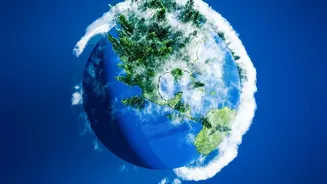
If this process continues for millions of years, what will be the result? Scientists using supercomputer simulations have a fascinating prediction: the complete closure of the Pacific Ocean and the formation of a new supercontinent. Researchers believe that in 200 to 300 million years, the Americas will collide with Asia, creating a massive landmass named 'Amasia'. This is part of a grand supercontinent cycle, where Earth's landmasses have repeatedly merged and broken apart over hundreds of millions of years. The last supercontinent, Pangaea, broke up around 200 million years ago, giving rise to the oceans and continents we know today. The shrinking of the Pacific is the next major step in this planetary dance.